Summary
Most procurement teams treat Supplier Relationship Management (SRM) as a post-contract formality rather than a commercial lever. This post breaks down how to move from reactive vendor management to a proactive SRM program built on segmentation, structured collaboration, and shared incentives. Readers will learn how to apply the Kraljic Matrix to prioritize effort, utilize AI-driven collaboration to eliminate manual friction, and measure the “hidden” value of SRM beyond Tier 1 price reductions. The goal is to transform your supply base from a list of vendors into a competitive engine for innovation and risk mitigation.
The “savings plateau” is a scenario every Category Manager eventually hits: you’ve squeezed the margins, consolidated the spend, and run the eAuctions, yet the business still demands more value. When price can no longer be the primary lever, the focus must shift to supplier relationship management strategies.
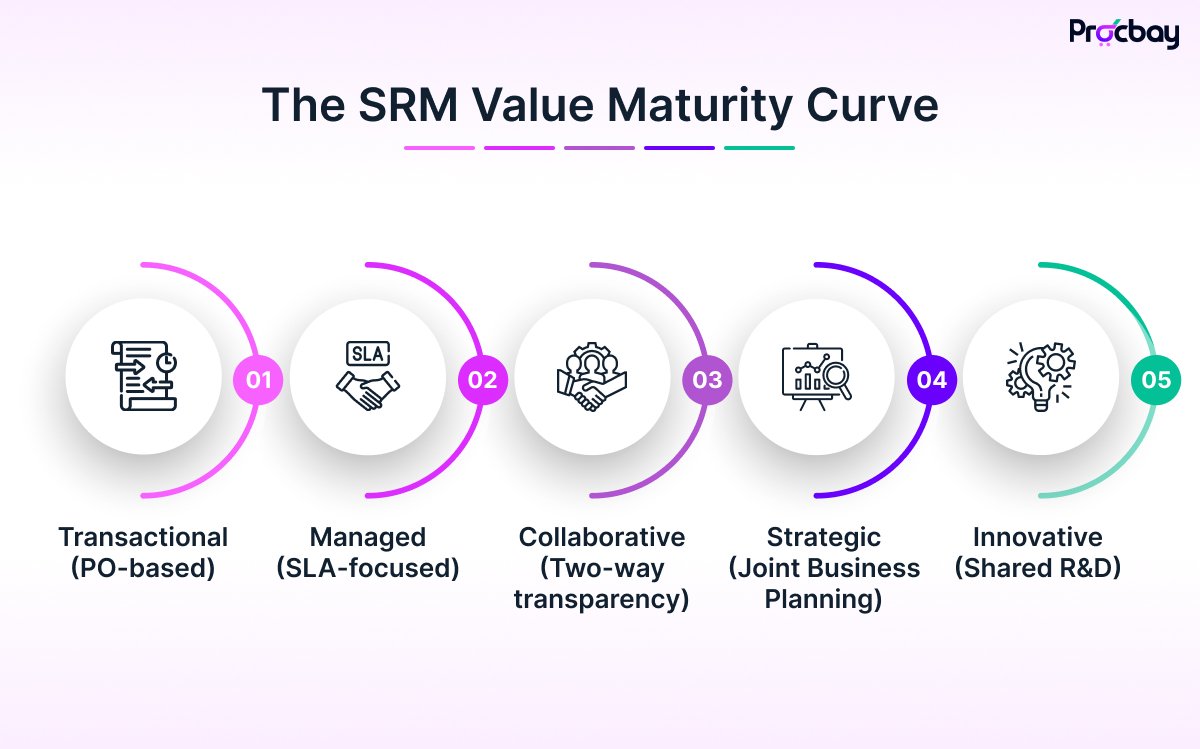
Most enterprises fail here because they mistake “being nice to vendors” for a strategy. True SRM is a disciplined, data-driven framework designed to extract maximum value from a supplier relationship over its entire lifecycle. It requires moving from a transactional mindset where communication only happens during a crisis or a renewal to a collaborative model where the supplier is incentivized to invest in your success.
The High Cost of Reactive Vendor Management
When SRM is neglected, the organization pays for it in “value leakage.” This isn’t just about overpaying; it’s about the cost of supply disruptions, missed innovation cycles, and the administrative burden of managing non-performing incumbents.
According to the Deloitte Global CPO Survey, high-performing procurement organizations are 2.5x more likely to focus on supplier collaboration as a primary lever for value creation compared to their peers. Without a structured approach, your team is likely spending 80% of its time on tactical troubleshooting for suppliers that represent only 20% of your strategic value.
To fix this, you must first acknowledge that not all suppliers are created equal. You cannot and should not manage a strategic software partner the same way you manage a stationery provider.

Segmentation: The Foundation of Any SRM Strategy
Effective relationship management strategies begin with segmentation. The most enduring framework for this remains the Kraljic Matrix. By mapping suppliers against “Supply Risk” and “Profit Impact,” you can determine where to deploy your most expensive resource: your team’s time.
| Supplier Segment | Relationship Objective | Primary Focus | Sourcing Approach |
| Strategic | Partnership & Integration | Long-term value, innovation | Joint business planning |
| Leverage | Competition & Volume | Cost reduction, TCO | RFx, eAuctions |
| Bottleneck | Continuity & Security | Risk mitigation, supply security | Long-term contracts, safety stock |
| Non-Critical | Efficiency & Automation | Process cost reduction | Catalogues, P-cards |
For Strategic suppliers, your strategy should involve joint business reviews (JBRs), shared roadmaps, and executive-level sponsorship. For Non-Critical spend, the strategy is simple: automate the workflow to minimize human intervention.
Did You Know?
While 70% of CPOs cite supplier collaboration as a top priority for driving innovation, fewer than 25% have the digital infrastructure in place to actually measure its impact on the bottom line. (Source: Deloitte — 2023 Global CPO Survey)
Three Pillars of an Effective SRM Program
Once segmented, your supplier relationship management program needs a delivery mechanism. Successful programs are built on three operational pillars:
-
Two-Way Transparency
If your only communication with a supplier is a purchase order or a dispute, you don’t have a relationship; you have a transaction. Strategic SRM requires sharing demand forecasts and long-term business goals. This transparency allows suppliers to optimize their own production or service capacity, which ultimately lowers your Total Cost of Ownership (TCO).
-
Structured Governance
A “Strategic” label means nothing without a meeting cadence. This includes:
- Operational Reviews (Monthly): Focused on KPIs, SLAs, and immediate performance gaps.
- Executive Reviews (Quarterly/Biannual): Focused on strategic alignment, innovation projects, and market trends.
-
Incentivized Innovation
Suppliers often have better visibility into market shifts and technological advancements than you do. A mature SRM strategy creates a “Customer of Choice” status, where the supplier brings new ideas, cost-saving technologies, or “first-look” inventory to you before your competitors.
| “The purchasing manager of the future must become a supply manager, capable of dealing with the complexities of global sourcing and the strategic implications of supply risk.”
— Peter Kraljic, Director Emeritus at McKinsey & Company |
| (Source: Harvard Business Review “Purchasing Must Become Supply Management”) |
The AI Advantage: Automating the Admin of SRM
The primary reason SRM programs fail is the administrative “tax.” Tracking performance across hundreds of suppliers via spreadsheets is unsustainable. This is where AI-orchestrated workflows change the math.
By leveraging a Supplier Collaboration Portal, enterprises can centralize communication, automate document collection, and move from manual data entry to exception-based management.
Instead of a Category Manager spending hours chasing a supplier for updated insurance certificates or KYC data, AI agents can handle the “heavy lifting” of compliance. This frees the human professional to focus on high-value activities, such as joint process improvement or risk mitigation strategies.
Measuring SRM Success Beyond the Price Point
How do you prove that an SRM strategy is working to a CFO who only looks at the “savings” column? You must track the “Hard” and “Soft” benefits of the relationship.
Research from The Hackett Group shows that world-class procurement organizations achieve significantly higher levels of “Value Beyond Savings”—specifically in areas of risk reduction and supplier-led innovation.
- Cost Avoidance: Tracking how a collaborative relationship prevented a price hike or a supply disruption.
- Cycle Time Reduction: Measuring how faster supplier onboarding and better communication speeds up the “intake-to-order” process.
- Risk Scores: Monitoring real-time changes in supplier financial health or compliance status.
Understanding the vendor lifecycle best practices is critical here. Every stage of the lifecycle, from onboarding to offboarding, is an opportunity to gather data that informs your broader SRM strategy.
Case Study: Toyota’s 50/50 Innovation Incentive
Toyota is widely cited as the gold standard for supplier relationship management strategies that drive commercial outcomes. Unlike traditional automotive OEMs that often use aggressive “price-down” mandates, Toyota utilizes a collaborative cost-reduction model.
When a supplier identifies a technical innovation that reduces manufacturing costs, Toyota typically shares the resulting savings on a 50/50 basis with that supplier. This structural incentive ensures that suppliers prioritize Toyota engineers for their best ideas, viewing Toyota as a “Strategic Customer” rather than an adversary. By treating the supplier’s motivation as a long-term asset, Toyota maintains a consistent pipeline of value-engineering tasks that sustain their competitive quality standards.
Conclusion
Building effective supplier relationship management strategies is a commercial necessity. By segmenting your supply base, establishing a governance structure, and leveraging AI to eliminate administrative friction, you move the procurement function from the back office to the boardroom.
Ultimately you want to orchestrate a supply network that is resilient, transparent, and aligned with your enterprise’s strategic goals. Start by identifying your top five strategic suppliers and asking: “If they had a breakthrough tomorrow, would they bring it to us first?” If the answer is no, your SRM strategy needs an overhaul.
If your team is struggling to move beyond tactical vendor management due to manual administrative overhead, seeing a live environment of AI-governed collaboration can provide a clear roadmap for change. Schedule a Demo with our experts, get the clarity you need in your procurement management.
FAQ
Q: What is the difference between SRM and vendor management?
A: Vendor management is typically tactical and transactional, focused on ensuring the supplier meets basic contractual obligations (price, delivery, quality). SRM is strategic and long-term, focused on building collaborative partnerships that drive mutual value, innovation, and risk mitigation.
Q: How do you measure the ROI of an SRM program?
A: ROI is measured through a combination of cost savings, cost avoidance (preventing price increases or disruptions), cycle time improvements, and value-adds such as supplier-led innovations or improved access to scarce resources.
Q: What is the Kraljic Matrix in procurement?
A: The Kraljic Matrix is a tool used to segment suppliers based on two dimensions: the complexity/risk of the supply market and the importance/profit impact of the purchase. This helps procurement teams decide which suppliers require strategic partnerships versus those that can be managed through automation.
Q: How does AI improve supplier relationship management?
A: AI improves SRM by automating administrative tasks like compliance tracking, KYC data collection, and performance monitoring. It provides predictive insights into supplier risk and spend patterns, allowing procurement managers to focus on strategic relationship building rather than manual data management.
Q: What are the most important KPIs for measuring Supplier Relationship Management success?
A: Success should be measured through a balanced scorecard that tracks both operational performance (Quality, On-time Delivery, SLA compliance) and strategic value (Joint cost-reduction initiatives, supplier-led innovation, and risk mitigation scores). Relying solely on price-based metrics often masks the true commercial value of a strategic partnership. Effective SRM KPIs must be co-developed with the supplier to ensure mutual alignment on what constitutes “success” for both organizations.
Connect with our procurement experts to tailor an AI-governed sourcing strategy for your enterprise.
Contact Us