Summary
The RFx process in procurement is the critical engine for market engagement, yet most sourcing teams still execute it manually across fragmented email threads and disconnected spreadsheets. This guide breaks down the commercial impact of standardizing your RFI, RFP, and RFQ workflows to eliminate data silos and accelerate cycle times. By transitioning from manual bid comparisons to an AI Procurement Orchestrator, category managers can replace instinct-based awarding with intelligent, governed sourcing events that protect margins and enforce compliance at the point of intake.
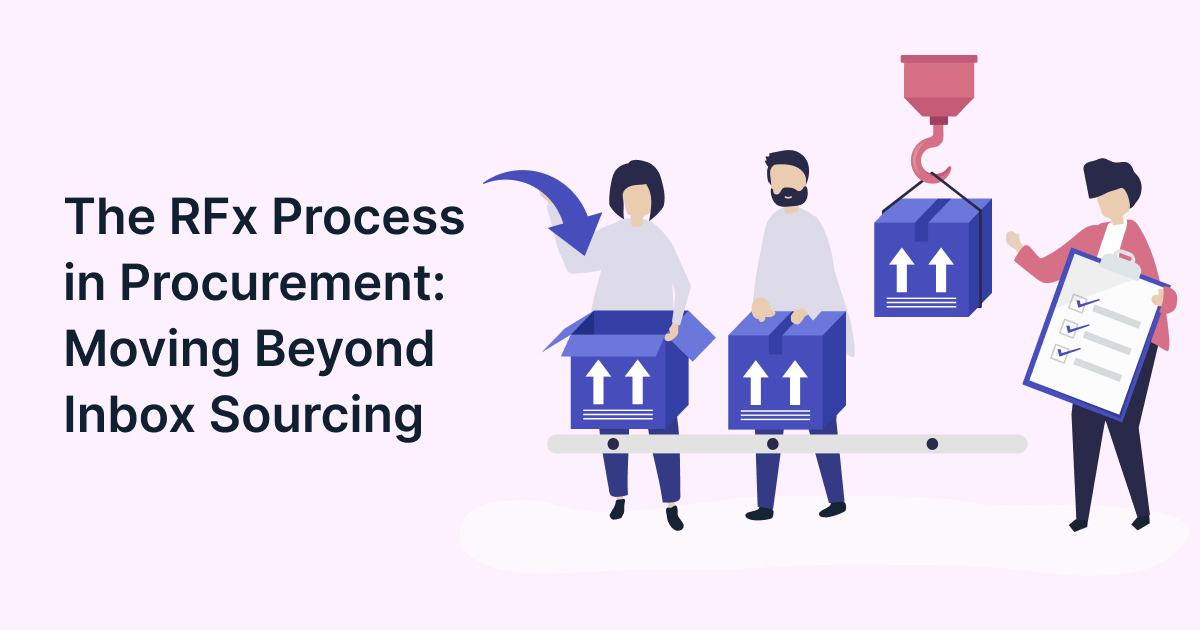
Category managers waste an average of two weeks per quarter simply chasing suppliers to return their bid spreadsheets. You send an RFP matrix to fifteen suppliers. Three miss the deadline. Five alter the cell formatting, breaking your master comparison sheet. The rest submit their pricing via unstructured PDF attachments that a junior buyer now has to manually key into your ERP.
This is the operational reality of a manual RFx process.
The friction isn’t just administrative annoyance; it translates directly to delayed speed-to-market, compromised bid visibility, and supplier concentration risk. When sourcing events are trapped in individual inboxes, procurement leadership loses the ability to govern the process, audit the decision criteria, or track the actual cost avoidance achieved.
Understanding the mechanics of an effective RFx workflow is the first step. Moving it out of email and into an orchestrated execution layer is what actually moves the needle on commercial outcomes.
Breaking Down the RFx Process: RFI, RFP, and RFQ
The term RFx is the catch-all acronym for the structured requests procurement uses to solicit information, proposals, or pricing from the supply base.
Using the wrong vehicle wastes supplier time and yields useless data. Using them in the correct sequence filters the market efficiently before you ever negotiate price.

The Strategic Sourcing Sequence
- RFI (Request for Information): Used when you are exploring a new category and need to understand market capabilities. You aren’t buying yet; you are shortlisting.
- RFP (Request for Proposal): Used when the problem is defined, but the solution is not. You are asking suppliers to propose an approach, methodology, and corresponding commercial model.
- RFQ (Request for Quotation): Used when the exact specifications, quantities, and delivery terms are locked. Price and SLA compliance are the only remaining variables.
Market Engagement Matrix
| Sourcing Vehicle | Primary Objective | Level of Detail Required | Expected Supplier Output | Commercial Goal |
| RFI | Market scoping and capability filtering | Low (General requirements) | Company overview, high-level capabilities | Build a qualified shortlist for a future event. |
| RFP | Solution design and value evaluation | High (Detailed business needs) | Technical methodology, SLA commitments, pricing structure | Evaluate Total Cost of Ownership (TCO) and strategic fit. |
| RFQ | Price discovery and execution | Exact (SKUs, blueprints, exact volumes) | Itemized pricing, delivery timelines | Secure the best unit economics for standardized goods. |
The Hidden Commercial Cost of Manual Sourcing
Running an RFx process manually inherently limits how many suppliers you can invite to an event. If a category manager knows they have to manually consolidate the data, they will cap the invite list at three or four known incumbents. This artificially restricts competition and guarantees you are leaving margin on the table.
The Commercial Impact of Sourcing Inefficiency:
- Transitioning from fragmented, manual workflows to AI-orchestrated source-to-contract (S2C) execution eliminates the “shadow costs” of inefficient procurement, consistently delivering 30–50% reductions in operational overhead. By replacing manual intervention with intelligent automation across the entire sourcing lifecycle, teams can reclaim up to 60% of their bandwidth to focus on high-value strategic decision-making. (McKinsey & Company)
- “Digital Masters,” as defined by the 2025 Deloitte Global CPO Survey, are distancing themselves from peers by scaling technology investment to 24%, and soon 26% of their total budget. This elite cohort is aggressively pivoting from basic digitization to agentic and generative AI, effectively hard-wiring automated, intelligent execution into their sourcing workflows to drive superior commercial ROI. (Deloitte Global CPO Survey)
When RFx tools for sourcing teams are absent, the default is instinct-based awarding. Without a centralized bid analysis framework, buyers naturally award contracts to the supplier they communicate with most easily, rather than the one offering the optimal risk-adjusted commercial value.
Did You Know?
World-class procurement organizations operate at 21% lower labor costs and require 29% fewer full-time equivalents (FTEs) than their peers, driven largely by the automation of routine sourcing and transactional execution tasks.
(Source: The Hackett Group — Procurement Benchmark Report)
Rebuilding Your Strategy with RFP Automation
Transitioning to RFP automation fundamentally changes what a category manager does all day. Instead of acting as an administrative project manager chasing deadlines, they become commercial strategists analyzing bid variance.
Modern RFQ tools force standard data structures. Suppliers log into a portal, enter their pricing into locked fields, and attach compliance certificates directly to their profile. The platform automatically flags non-compliant bids, scores technical responses against predefined weightings, and instantly generates a side-by-side bid comparison.
This governance must extend beyond the award phase. The supplier vetting done during the RFx stage must feed seamlessly into your broader risk frameworks. Sourcing leaders must integrate these initial assessments by understanding how to implement a TPRM lifecycle strategy directly from the point of supplier intake.
Furthermore, the commercial terms negotiated in the winning RFP are useless if they degrade over the life of the agreement. Connecting your sourcing event data to tools that utilize AI automation for contract compliance tracking ensures the SLAs promised in the bid actually materialize in the execution phase.
| “Purchasing must become supply management… It must shift its focus from an operational, administrative activity to a strategic one.”
— Peter Kraljic, Director at McKinsey & Company (Creator of the Kraljic Matrix) |
| (Source: Harvard Business Review) |
Moving Procurement from Administration to Execution
The RFx process is the focal point where market intelligence meets commercial execution. If you are managing this phase through static documents, your procurement function is structurally capped in the value it can deliver.
RFP automation and intelligent RFQ tools are no longer emerging technologies; they are the baseline requirements for running a competitive sourcing organization. By replacing email-driven chaos with orchestrated, AI-governed workflows, procurement leaders can finally stop managing spreadsheets and start managing supply chain risk and enterprise profitability.
If your sourcing team is losing weeks to manual bid consolidation and fragmented email threads, it is time to move your RFx events into an intelligent execution engine. Contact us and a brief platform walkthrough with our experts to show you exactly how automated bid analysis accelerates cycle times.
FAQ
Q: What is the difference between an RFP and an RFQ in the rfx process?
A: An RFP (Request for Proposal) is used when you have a business problem and need suppliers to propose a solution, methodology, and price. An RFQ (Request for Quotation) is used when your specifications are completely locked and you only need suppliers to compete on price and delivery terms.
Q: How does RFP automation reduce sourcing cycle times?
A: RFP automation eliminates the manual administrative tasks of sourcing, such as emailing attachments, chasing suppliers for responses, and manually transcribing bid data into master spreadsheets. By centralizing the event in a portal, bid comparisons are generated instantly, cutting weeks off the evaluation phase.
Q: Why is managing an RFx process through email considered a risk?
A: Email-based sourcing limits visibility and governance. It prevents procurement leadership from auditing how a supplier was selected, increases the likelihood of human error in bid transcription, and makes it impossible to securely manage sensitive supplier data or compliance documentation.
Q: What role do RFQ tools play in managing tail spend?
A: RFQ tools allow procurement to rapidly execute three-bids-and-a-buy policies for low-value or unplanned purchases with minimal administrative effort. This brings structure and competition to tail spend, which is otherwise often lost to maverick purchasing outside of negotiated contracts.
Q: How does an AI orchestrator improve bid analysis?
A: An AI orchestrator automatically parses incoming supplier proposals, normalizes unstructured data, and maps responses against your predefined scoring matrix. This flags hidden risks, highlights non-compliant SLA terms, and provides a clear Total Cost of Ownership (TCO) breakdown instantly.
Connect with our procurement experts to tailor an AI-governed sourcing strategy for your enterprise.
Contact Us