Summary
Evaluating your operating model means confronting the friction between business unit autonomy and enterprise-wide spend control. The core tension lies in choosing the right framework to eliminate maverick spend without bottlenecking localized purchasing needs. By implementing a centralized procurement approach, organizations gain visibility, standardize their centralized procurement process, and aggregate volume for better contract terms. Readers will understand how to weigh centralized vs decentralized procurement advantages, integrate AI into their sourcing operations, and utilize tools like Contract Intelligence to enforce compliance across the enterprise.
Business unit leaders want to buy what they need, exactly when they need it. Finance leaders want total visibility into enterprise spend. This inherent conflict is why defining your centralized procurement approach is rarely a simple decision.
When regional offices manage their own suppliers, maverick spend spikes. When headquarters mandates every purchase order, cycle times drag, and operational agility drops. You do not need another theoretical debate about operating models; you need a structured procurement strategy that balances control with speed. Transforming your sourcing operations requires a clear understanding of your organizational maturity, your category constraints, and how modern digital orchestration bridges the gap between local flexibility and global governance. In this guide, you will learn how to evaluate centralized vs decentralized procurement advantages to build a model that actually works.
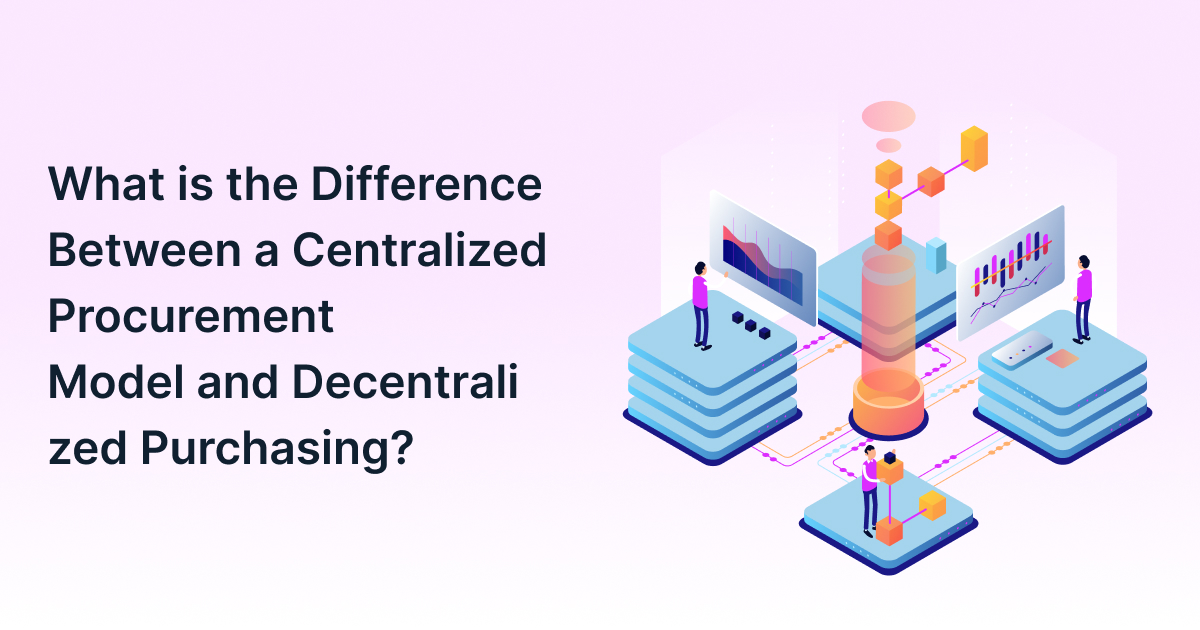
What is the Difference Between a Centralized Procurement Model and Decentralized Purchasing?
Before evaluating centralized vs decentralized procurement advantages, you must define the boundaries of each framework within your procurement strategy.
In a pure centralized procurement model, a single, dedicated team at corporate headquarters manages all strategic sourcing, contract negotiation, and supplier relationships. This centralized procurement unit mandates the centralized procurement process for all business units. Conversely, a decentralized model gives regional managers the authority to execute their own sourcing operations, resulting in localized supplier relationships but fragmented spend data.
To realize the benefits of centralized procurement, leaders must acknowledge that a centralized procurement process requires robust data governance. Without it, the centralized procurement model simply becomes an administrative bottleneck rather than a strategic driver. Every procurement strategy must account for this reality. The best sourcing operations apply a centralized procurement model for strategic categories while pushing tactical buys to the edges. When analyzing centralized vs decentralized procurement advantages, you realize that centralized procurement works best as an intelligent orchestration layer.

How Do Centralized vs Decentralized Procurement Advantages Impact the Bottom Line?
Weighing centralized vs decentralized procurement advantages requires looking past simple cost-cutting. Each approach serves a different procurement strategy.
When comparing centralized vs decentralized procurement advantages, the centralized procurement process clearly wins on scale. Aggregating demand allows your sourcing operations to negotiate tiered pricing and stronger service level agreements (SLAs). However, reviewing centralized vs decentralized procurement advantages also reveals that decentralized teams move faster on low-value, urgent tactical buys.
To maximize the benefits of centralised procurement, your procurement strategy must dictate which categories demand strict governance. By analyzing centralized vs decentralized procurement advantages, leaders often find that direct materials benefit heavily from a centralized procurement model, while indirect regional facilities spend might require localized flexibility.
The ultimate goal of studying centralized vs decentralized procurement advantages is to build hybrid sourcing operations. You must assess centralized vs decentralized procurement advantages to determine where a centralized procurement process reduces third-party risk. Ultimately, the best centralized vs decentralized procurement advantages are realized when AI orchestrates the workflow.
Structuring Your Evaluation
| Metric | Centralized Procurement Model | Decentralized Procurement |
| Spend Visibility | Total enterprise transparency | Fragmented, siloed reporting |
| Supplier Leverage | High (Aggregated volume) | Low (Diluted purchasing power) |
| Cycle Time | Slower (Requires strict intake) | Faster (Direct business purchasing) |
| Contract Compliance | Standardized, governed terms | Variable, localized risk |
| Strategic Focus | Category management & TPRM | Tactical fulfillment & firefighting |
What are the Key Benefits of Centralized Procurement for Enterprise Sourcing Operations?
The benefits of centralized procurement extend far beyond simple volume discounts. A well-executed centralized procurement process transforms sourcing operations into a risk-mitigation engine.
One of the core benefits of centralized procurement is standardizing compliance. When every contract flows through a centralized procurement model, legal and finance teams can enforce indemnity clauses and payment terms uniformly. The benefits of centralized procurement also include massive reductions in duplicated effort; a single category manager runs the sourcing operations for IT hardware rather than ten regional IT directors running their own centralized procurement process.
To achieve the benefits of centralized procurement, you need a cohesive procurement strategy. The benefits of centralized procurement fail to materialize if user adoption is low. Therefore, the benefits of centralized procurement rely on implementing an intuitive centralized procurement process. Capturing the benefits of centralized procurement requires digital tools like Supplier Lifecycle Management to onboard vendors consistently.
Furthermore, the benefits of centralized procurement are visible in audit defense. Clear audit trails are inherent benefits of centralized procurement. You cannot fully measure the benefits of centralized procurement until you capture your long-tail spend.
Did You Know?
According to The Hackett Group’s benchmark data, top-performing procurement organizations that centralize and digitize their operations reduce maverick buying and contract noncompliance, resulting in 60% less savings lost compared to their peers.
(Source: The Hackett Group — Digital World Class Procurement Teams Achieve 2.6X Higher ROI, 2025)
What Data Should Drive Your Procurement Strategy Updates?
To justify migrating to a centralized procurement model, rely on documented operational metrics rather than instinct. Data from leading research firms highlights the direct commercial consequences of how you structure your sourcing operations.
Data on Sourcing Operations and Centralization
- 81% procurement leaders perceive IT and software as prime categories subjecting to cost leakage due to the decentralized nature of the purchases of these services. (CPO Strategy)
This lack of visibility is a primary driver for adopting a strict centralized procurement process to rein in maverick purchasing.
- Top-performing procurement teams executing a unified procurement strategy operate with 31% fewer full-time employees and at 19% lower cost as a percentage of spend. [Source: The Hackett Group] This proves that centralized procurement drives immense functional productivity.
Illustrative Example
A global manufacturing enterprise operating across 14 countries struggled with severely fragmented sourcing operations. Each regional facility managed its own MRO (Maintenance, Repair, and Operations) suppliers, resulting in zero leveraged volume.
By shifting to a centralized procurement model, the CPO instituted a unified procurement strategy. They deployed a centralized procurement process for all strategic supplier negotiations, leaving only low-threshold emergency buys to the local teams. The centralized procurement initiative yielded a 14% reduction in MRO category spend within 12 months. This outcome clearly demonstrates the centralized vs decentralized procurement advantages when shifting sourcing operations toward a governed, centralized procurement model. They further optimized their savings by closely monitoring procurement KPIs every business should track.
How Does AI Modernize the Centralized Procurement Process?
Migrating to a centralized procurement model does not mean stripping all power from local teams. It means applying the right procurement strategy to the right spend tier.
Your sourcing operations need an intelligent intake layer. A modern centralized procurement process uses AI to route requests. If a regional manager needs custom software, the centralized procurement framework automatically triggers a security review. This makes the centralized procurement process invisible but highly effective.
A rigid procurement strategy fails if it ignores local realities. Therefore, the centralized procurement model must accommodate regional regulatory differences. Refining your sourcing operations means you centralize the contract but decentralize the delivery schedule. By understanding centralized vs decentralized procurement advantages, you can tailor your procurement strategy effectively. Additionally, attacking unmanaged purchases through a centralized procurement process helps execute tail spend management, capturing hidden savings across all sourcing operations.
Conclusion:
Every CPO must continually assess centralized vs decentralized procurement advantages. The benefits of centralised procurement are undeniable for core categories. The benefits of centralised procurement compound over time as data pools in your centralized procurement model. A robust procurement strategy relies on efficient sourcing operations governed by a strict centralized procurement process.
If your enterprise is struggling to balance regional autonomy with global spend visibility, evaluating your centralized vs decentralized procurement advantages is the critical first step. By deploying an AI-orchestrated centralized procurement model, you can enforce your procurement strategy, streamline your centralized procurement process, and elevate your sourcing operations to true strategic value drivers.
Your team might be evaluating how to bring AI-governed structure to your sourcing events and effectively manage a centralized model without slowing down the business as its what these modern times require. Contact us for a 30-minute platform walkthrough can show you what that looks like in practice.
FAQ
Q: What is centralized procurement?
A: Centralized procurement is an operating model where a single, corporate-level team manages all strategic sourcing operations, vendor negotiations, and contract lifecycle management for the entire enterprise, ensuring maximum volume leverage and strict compliance.
Q: How does a centralized procurement strategy reduce maverick spend?
A: By forcing all purchase requests through a standardized, AI-governed intake process, a centralized model prevents business units from buying off-contract or engaging unapproved suppliers, drastically lowering maverick spend.
Q: When should an enterprise use a decentralized purchasing approach?
A: Decentralized purchasing is highly effective for low-value, urgent tactical buys, or highly specialized regional services where local business units need immediate fulfillment without waiting for corporate sourcing approvals.
Q: How does AI improve the centralized procurement process?
A: AI acts as the orchestration layer, automatically routing intake requests, categorizing spend data globally, and providing category managers with predictive insights, preventing the corporate procurement team from becoming an administrative bottleneck.
Q: What is the best way to balance centralized control with local agility?
A: The most effective framework is a center-led hybrid model: strategic sourcing, heavy negotiations, and TPRM are executed centrally, while local teams are empowered to place call-off orders against established global catalogs and enterprise-wide master service agreements.
Connect with our procurement experts to tailor an AI-governed sourcing strategy for your enterprise.
Contact Us