Summary
Unmanaged indirect spend leaks margins through fragmented purchases, off-contract pricing, and invisible supplier risk across decentralized departments. Resolving this requires directing employees to a governed buying channel they actually want to use, rather than relying on slow, manual approvals. By implementing a smart procurement catalogue, enterprise teams can automate compliance and capture granular line-item data without slowing down business operations. To move from reactive tracking to proactive governance, explore ProcBay’s Smart Catalogue Management to centralize your indirect spend management strategy.
In short: A smart procurement catalogue centralizes indirect spend by directing employees to pre-negotiated, compliant suppliers through a familiar e-commerce interface. This eliminates rogue purchasing, captures accurate line-item data for indirect spend analysis, and enforces budget control automatically at the point of intake.
Every Monday morning, decentralized purchasing chips away at enterprise margins. A marketing manager hires an unvetted local design agency to meet a campaign deadline. An IT director buys fifty software licenses on a corporate credit card. A facility manager orders emergency repair supplies from a non-compliant vendor.
This fragmented activity makes indirect spend management a massive financial blind spot for procurement and finance teams. Fixing this leakage does not require policing every transaction manually. You need structural governance built directly into the intake process.
By deploying a procurement catalogue for indirect spend management, category managers lock in negotiated rates. They ensure budget compliance. They provide internal stakeholders with a fast path to the tools they need.
Why Is Indirect Spend Management So Difficult to Control?
To control indirect spend, you need total visibility into category-level purchasing before the transaction occurs, replacing fragmented departmental buying with centralized intake channels.
Direct materials receive heavy scrutiny because they tie directly to a bill of materials and impact the final manufactured product. As defined by the Chartered Institute of Procurement & Supply (CIPS), indirect spend lacks this built-in structure. Different departments hold their own budgets.
Department heads make decentralized purchasing decisions without procurement oversight. This creates a long tail of unmanaged suppliers.
According to The Hackett Group’s 2026 Procurement Key Issues Benchmark, organizations with low procurement maturity see up to 40% of their indirect spend flow through completely unmanaged channels.
This rogue purchasing directly erodes negotiated savings. It also exposes the business to unvetted supplier risk. Without a central repository for approved items, employees take the path of least resistance.
When procurement acts only as a final hurdle for approval, rather than a facilitator of the purchase, employees view the department as a bottleneck. They avoid the formal process entirely.

How Does a Procurement Catalogue Bring Rogue Spend Into Policy?
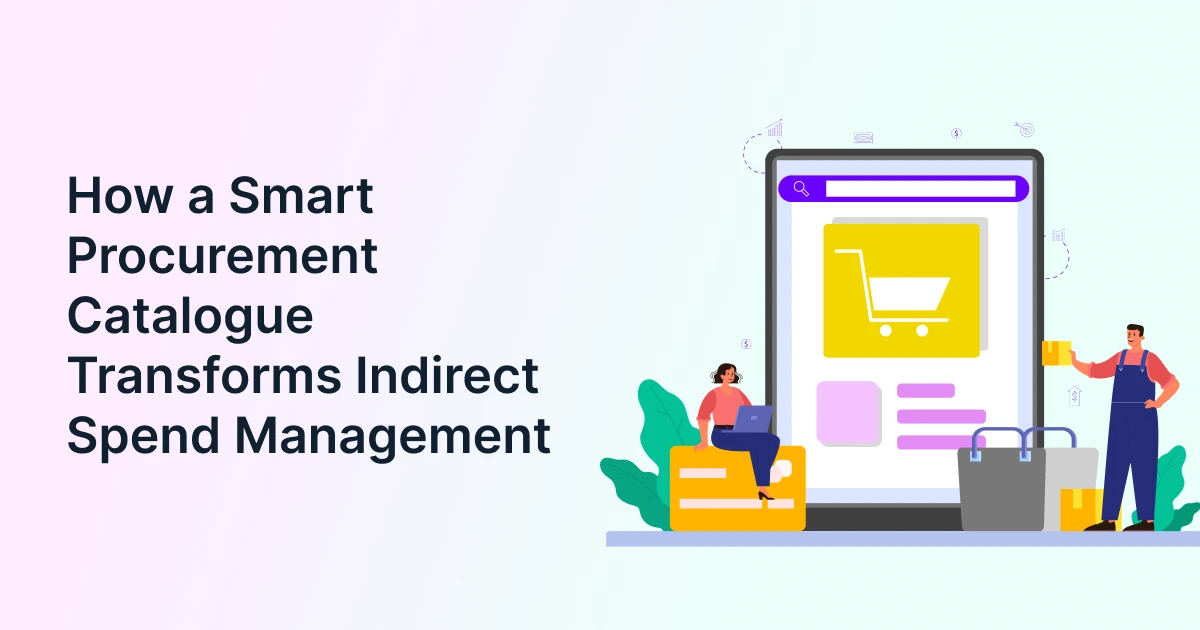
To bring rogue spend into policy, you need a smart procurement catalogue that mimics consumer e-commerce, offering employees pre-approved items from contracted suppliers at negotiated rates.
A well-structured catalog changes the buying behavior of the entire organization. When an IT manager needs peripherals or server space, they search a centralized portal. The system instantly filters results to show only active Master Services Agreements (MSAs) and negotiated line items.
This removes the guesswork from purchasing. Purchasing automation takes over the moment a user clicks order. Budget limits apply automatically based on the user’s departmental cost center. Approvals route to the correct manager without manual email trails.
Did You Know?
Best-in-class procurement organizations manage over 85% of their total indirect spend centrally, compared to less than 50% for peer groups, largely by enforcing catalog-based buying compliance across their enterprise.
(Source: The Hackett Group: 2026 Procurement Key Issues Benchmark)
The user interface matters immensely here. If the internal catalogue is harder to navigate than a standard external B2B website, adoption will fail. The system must support punch-out catalogs that connect directly to major suppliers, ensuring real-time inventory and pricing accuracy.
Why Restrictive Purchasing Policies Actually Increase Maverick Spend
Procurement teams often respond to budget leakage by adding more approval layers. This approach consistently fails. When the purchase requisition process takes three weeks for a $500 software license, employees circumvent the system. They use expense cards. They split invoices to stay under approval thresholds.
Compliance cannot rely on friction. It must rely on user experience. If the compliant purchasing channel is faster than the rogue channel, maverick spend drops naturally. A smart catalog provides that speed.
If you’re wondering whether a rigid, mandatory approval matrix is enough to fix indirect spend leakage, here’s the short answer: No. Employees will always find a workaround if the approved internal process takes longer than their actual project deadline.
Tactical Purchasing vs. Automated Spend Control
To transition from tactical purchasing to automated spend control, you need systems that enforce compliance at the point of search rather than relying on manual audits after the invoice arrives.
| Capability | Tactical Purchasing | Automated Spend Control |
| Intake Method | Free-text emails, phone calls, and unstructured PDF forms. | Guided search within a centralized procurement catalogue. |
| Pricing Compliance | Checked manually against legacy contracts stored in shared drives. | Locked automatically to pre-negotiated supplier catalogs and MSAs. |
| Approval Routing | Manual email chains requiring constant follow-up and reminders. | Rules-based routing triggering instant approvals based on budget limits. |
| Supplier Risk | Vendors added ad-hoc without formal KYC or security checks. | Employees only see pre-vetted suppliers with active risk profiles. |
| Data Quality | Vague descriptions leading to poor indirect spend analysis. | Clean, item-level taxonomy mapped precisely to category codes. |
What Are the Hidden Costs of Unmanaged Indirect Spend?
To avoid the severe financial consequences of unmanaged indirect spend, you need to recognize that inaction leads directly to margin erosion, supplier concentration risk, and failed compliance audits.
Every off-contract purchase represents lost negotiating leverage. If your company spends $5 million annually on facilities maintenance across forty different local vendors, you have zero leverage. Consolidating that spend under three managed suppliers yields immediate volume discounts. You cannot achieve this consolidation if you cannot see the spend happening in real-time.
Furthermore, invisible spend carries invisible risk. Bringing unknown software vendors into your tech stack via corporate cards creates shadow IT. This introduces severe data privacy and security vulnerabilities. By routing requests through managed channels, you ensure every supplier has passed basic risk checks.
Procurement spend control demands immediate data. Clean purchasing channels allow finance teams to track financial commitments in real-time. This prevents budget overruns before cash actually leaves the business.

Case Study: Reclaiming Margins Through Purchasing Automation
To understand the impact of purchasing automation, you need to look at enterprise deployments where digitizing indirect catalogs reduced purchase cycle times by more than half while completely eliminating invoice discrepancies.
According to data in Deloitte’s 2025 Global Chief Procurement Officer Survey, high-performing teams deploy advanced digital tools to achieve superior spend visibility. Consider a documented industry pattern: a mid-sized manufacturing enterprise struggling with decentralized IT, MRO, and marketing spend.
This organization carried over 4,000 active indirect suppliers on its master vendor list. Category managers wasted hours auditing expense reports and chasing down rogue buyers. By rolling out a procurement catalogue for indirect spend management, they fundamentally changed the process.
The system automatically blocked non-compliant purchases at the requisition stage. Cycle times for standard items dropped from twelve days to under four hours. The finance team gained accurate line-item data for future contract negotiations. Ultimately, the firm reduced its active indirect vendor base by 60%, driving higher volumes to preferred suppliers and securing an additional 12% in negotiated savings.
Conclusion
Fragmented indirect purchasing drains enterprise margins and creates unnecessary compliance risks. You cannot fix this with stricter policy memos or longer approval chains. True governance requires a system that makes doing the right thing the easiest and fastest option for your employees.
A smart procurement catalogue bridges the gap between end-user convenience and procurement control. It locks in negotiated savings, accelerates purchasing cycles, eliminates shadow IT, and delivers the clean data needed for strategic category planning.
If your team is evaluating how to bring AI-governed structure to your indirect purchasing channels, talk to us and we will map out the exact plan matched to your requirements.
FAQ
Q: What is the difference between direct and indirect spend management?
A: Direct spend management focuses on the raw materials and components that go directly into manufacturing your end product. Indirect spend management handles the goods, services, and software required to run the business, such as IT licenses, office supplies, and facilities maintenance. Indirect spend is historically harder to track due to decentralized buying habits.
Q: How do you measure procurement spend control effectiveness?
A: You measure procurement spend control effectiveness by tracking the percentage of total spend under management (SUM), the rate of maverick or off-contract spending, and the average purchase order cycle time. High spend under management indicates strong structural governance.
Q: Why do manual purchasing policies fail to stop maverick spend?
A: Manual purchasing policies fail to stop maverick spend because they introduce too much friction. When the approved requisition process takes weeks for a low-dollar item, employees use expense cards to meet their immediate project deadlines. Speed drives compliance.
Q: What features should a procurement catalogue for indirect spend management include?
A: A procurement catalogue for indirect spend management must include an intuitive e-commerce interface, real-time budget checking, automated approval routing, and locked line-item pricing tied directly to active supplier contracts and MSAs.
Q: How does purchasing automation improve indirect spend analysis?
A: Purchasing automation improves indirect spend analysis by capturing accurate, categorized data at the exact point of order. Instead of auditing vague free-text descriptions on an invoice months later, procurement teams receive structured data mapped precisely to internal category codes.
Q: How do I get employees to actually use an internal procurement catalogue?
A: You get employees to actually use an internal procurement catalogue by ensuring it mirrors the speed and ease of consumer e-commerce platforms. The search function must be accurate, the checkout process fast, and the approval routing instant for standard, low-risk purchases.
Q: What is shadow IT, and how does a catalogue prevent it?
A: Shadow IT occurs when departments buy software without IT or procurement oversight. A procurement catalogue prevents this by restricting software purchases to pre-vetted tools that have already passed security and compliance checks, blocking rogue card transactions.
Q: How does a catalogue impact tail spend?
A: A catalogue directly impacts tail spend by capturing the large volume of low-value, decentralized purchases that normally bypass formal procurement. It channels these routine transactions to preferred suppliers, consolidating the vendor base.
Connect with our procurement experts to tailor an AI-governed sourcing strategy for your enterprise.
Contact Us