The way procurement runs today has changed significantly. It has moved from a tactical framework to a strategic framework. A few years ago, teams managed supplier lists in spreadsheets, handled approvals over email, and tracked contracts across multiple systems. It wasn’t perfect, but it worked.
Today, that approach is starting to break down. Companies are dealing with more suppliers, stricter compliance requirements, higher spend visibility expectations, and growing pressure to deliver savings. At the same time, employees expect business buying to feel as simple as online shopping. That creates a challenge.
Procurement teams need control. Whereas, employees want convenience and finance wants visibility. On the other hand, leadership wants cost savings. This is exactly where smart procurement catalogues are reshaping procurement operations.
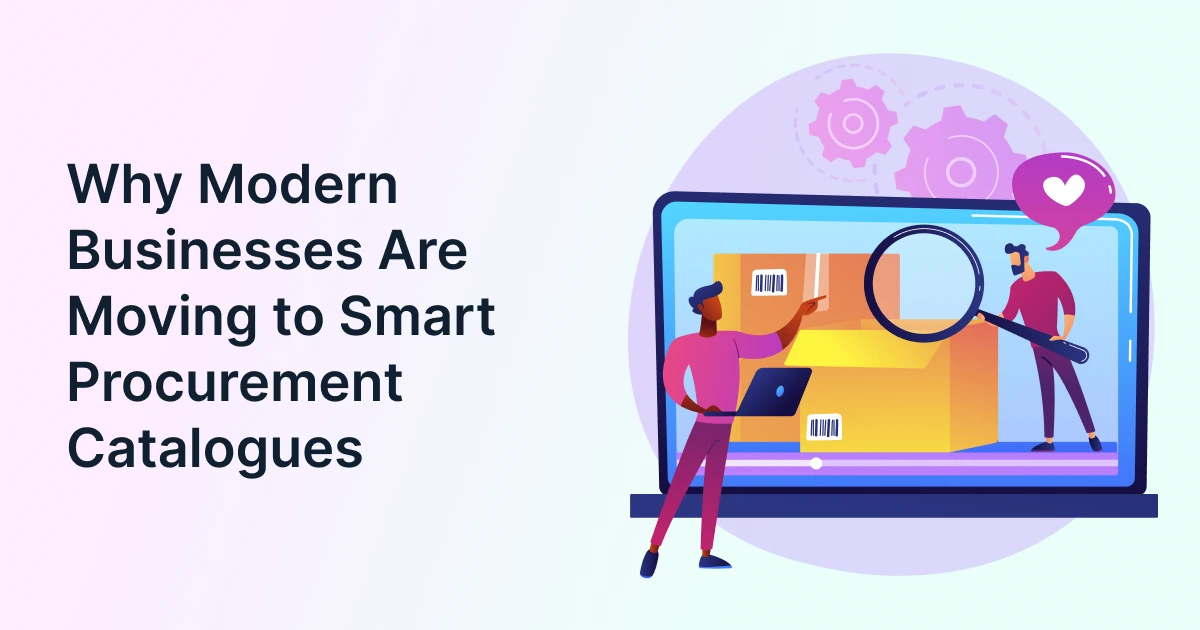
As part of a broader procurement ecosystem, smart procurement catalogues work alongside automated workflows, supplier management, and real-time visibility tools to help organizations create a purchasing experience that is both controlled and easy to use.
Modern businesses are increasingly investing in cloud procurement solutions, digital procurement capabilities, and cloud-based procurement solutions to remove complexity from purchasing while improving governance and compliance. Let’s explore why.

Traditional vs Cloud-Based Procurement Catalogues
| Capability | Traditional Approach | Cloud Procurement Software |
| Supplier Catalogues | Manual updates | Real-time updates |
| Contract Visibility | Limited | Always accessible |
| Purchase Requests | Email-driven | Automated |
| Compliance Tracking | Reactive | Built-in |
| Purchase Orders | Manual creation | Automated generation |
| Invoice Processing | Separate systems | Connected workflows |
| Spend Visibility | Delayed reporting | Real-time dashboards |
| Supplier Experience | Fragmented | Connected |
| Scalability | Limited | Enterprise-ready |
| User Experience | Complex | Consumer-like |
Key Takeaways
- Cloud procurement software centralizes approved suppliers, contracts, pricing, and purchasing activity.
- Smart procurement catalogues reduce maverick spending and improve compliance.
- Organizations can automate requisitions, purchase orders, invoice matching, and approvals.
- Hosted and punchout catalogues simplify supplier interactions.
- A modern SaaS procurement platform improves both user experience and procurement control.
- AI-powered catalogue management helps buyers find the right suppliers faster.
- Cloud procurement solutions provide end-to-end visibility from sourcing to payment.
Why Are Traditional Procurement Processes Failing?
Traditional procurement processes struggle because they were never designed for today’s speed and complexity. Multiple systems, disconnected data, manual approvals, and email-driven communication create inefficiencies that impact every stakeholder. As organizations grow, these issues become impossible to ignore.
Procurement Has Become More Complex
Most businesses now manage hundreds or thousands of suppliers. Each supplier comes with contracts, pricing agreements, compliance requirements, and service expectations. Managing all of this manually creates unnecessary administrative work and increases risk.
Employees Buy Outside Approved Channels
When approved suppliers are difficult to find, employees create their own shortcuts. They buy from familiar vendors. They skip procurement. They ignore negotiated agreements. The result is reduced savings and weaker compliance.
Contracts Often Stay Hidden
Many procurement teams negotiate excellent commercial terms. But if employees cannot easily find approved products or contract-based pricing, those negotiated benefits never get used. That’s where procurement value starts leaking away.
Common Signs Your Procurement Process Needs Improvement
- Email-based requests: Procurement requests arrive from everywhere. Hence, approvals take longer, information gets lost, and teams struggle to track progress.
- Duplicate supplier purchases: Different departments buy the same items differently. Consequently, spend becomes fragmented, savings opportunities are missed, and supplier consolidation becomes difficult.
- Poor contract adoption: Here, contracts exist but are rarely utilized. So, compliance decreases, costs increase, and procurement loses leverage.
- Lack of spend visibility: Finance teams often discover issues after spending occurs. Consequently, budget control weakens, forecasting suffers, and reporting becomes more reactive.
So, the biggest challenge isn’t finding suppliers anymore. It’s creating a purchasing process that people actually follow.
How Does Cloud Procurement Software Solve Everyday Procurement Challenges?
Cloud procurement software solves procurement challenges by bringing suppliers, smart procurement catalogues, contracts, sourcing events, and purchasing workflows into one centralized platform. It helps businesses improve compliance, automate routine tasks, and gain visibility across the procurement lifecycle.
This is why organizations are rapidly adopting cloud procurement software as part of broader digital procurement initiatives.
It Creates One Place to Buy
Instead of searching through emails, spreadsheets, internal portals, and supplier websites, employees access one platform. Everything they need is available in a single location. This makes buying easier while improving governance.
It Reduces Manual Procurement Work
Procurement professionals spend too much time chasing approvals, validating requests, and tracking purchase activity. A modern cloud procurement system automates these repetitive activities. Teams can focus on strategic sourcing instead of administrative tasks.
It Improves Purchasing Compliance
When approved products and suppliers are easier to access than unapproved options, compliance naturally improves. Employees follow the preferred buying path because it is the simplest path.
It Connects Upstream and Downstream Procurement
Good procurement starts before purchase orders and continues after ordering. A connected SaaS procurement platform supports the entire process.
The upstream benefits of smart procurement catalogues include better purchasing compliance, better lead times, pre-negotiated commercial terms, and improved payment terms. This in turn:
- Improves policy adherence
- Reduces maverick spending
- Supports governance
- Faster ordering
- Fewer delays
- Improved operational efficiency
- Better savings realization
- Reduced pricing inconsistencies
- Improved supplier utilization
- Supports working capital goals
- Reduces payment disputes
- Creates consistency
Now, the downstream benefits of smart procurement catalogues include automated purchase requisition generation, digital purchase order creation, automated invoice processing, and contract utilization tracking. This:
- Reduces manual effort: Routine tasks like creating requisitions and processing approvals happen automatically, freeing procurement teams to focus on strategic work.
- Improves speed: Requests move through predefined workflows faster, reducing delays in purchasing cycles.
- Standardizes workflows: Every purchase follows a consistent process, ensuring compliance and reducing process variations across departments.
- Improves accuracy: Automated data capture and validation minimize human errors in orders, pricing, and supplier information.
- Reduces paperwork: Digital documents replace manual forms and spreadsheets, making procurement more efficient and organized.
- Enhances control: Built-in approval rules and purchasing policies ensure every transaction follows company guidelines.
- Faster reconciliation: Invoices, purchase orders, and receipts are automatically matched, speeding up financial reviews.
- Fewer errors: Automated workflows eliminate duplicate entries and manual mistakes that commonly occur in procurement processes.
- Better visibility: Real-time access to procurement data helps stakeholders track spending, suppliers, and purchasing activity.
- Improves reporting: Consolidated procurement data enables more accurate and actionable performance reports.
- Supports negotiations: Detailed spend and supplier data provide stronger insights for contract renewals and pricing discussions.
- Maximizes contract value: Organizations can ensure negotiated pricing, terms, and supplier agreements are consistently used across purchases.
| Upstream Benefits | Downstream Benefits |
| Improves policy adherence | Reduces manual effort |
| Reduces maverick spending | Improves speed |
| Supports governance | Standardizes workflows |
| Faster ordering | Improves accuracy |
| Fewer delays | Reduces paperwork |
| Improved operational efficiency | Enhances control |
| Better savings realization | Faster reconciliation |
| Reduced pricing inconsistencies | Fewer errors |
| Improved supplier utilization | Better visibility |
| Supports working capital goals | Improves reporting |
| Reduces payment disputes | Supports negotiations |
| Creates consistency | Maximizes contract value |
Ask any procurement manager about their daily frustrations, and they’ll describe problems that modern cloud procurement software was built to solve.
What Should Businesses Look for in Cloud-Based Procurement Catalogue Software?
Not all smart procurement catalogues are equal. Some simply store supplier information. Others actively drive better purchasing decisions. The difference can have a major impact on procurement performance. Let’s go through them one by one.
Look Beyond Product Listings
A smart procurement catalogue should do more than display products. It should connect sourcing events, contracts, supplier information, approvals, and purchasing activity. That is what delivers genuine business value.
Prioritize User Adoption
Even the most advanced cloud-based procurement software will fail if employees don’t use it. Users should be able to search, compare, and order with minimal training. A good buying experience is often the foundation of compliance.
Support Different Smart Procurement Catalogue Models
Organizations work with different supplier relationships, and not every supplier operates in the same way. The solution should support multiple smart procurement catalogue approaches so procurement teams can manage diverse purchasing needs without creating unnecessary complexity.
A flexible smart procurement catalogue structure also makes it easier to onboard suppliers, accommodate category-specific requirements, and provide buyers with the most convenient purchasing experience while maintaining compliance. This ensures procurement can scale efficiently as supplier networks and business requirements grow.
Smart Procurement Catalogue Types Every Organization Should Consider
- Hosted Catalogues: Supplier content is maintained within the platform. This gives better control, easier updates, and simplified administration.
- Punchout Catalogues: Users buy directly from supplier websites. This offers real-time product information, accurate pricing, and seamless supplier integration.
- Dynamic Catalogue Matching: AI recommends suitable products and suppliers. This helps in faster decisions, better compliance, and improved buying accuracy.
- Smart Product Discovery: Helps users quickly find approved products, improving adoption, reducing procurement friction, and supporting compliant buying.
Many organizations pursuing procurement transformation begin by improving catalogue control because it directly influences compliance, supplier usage, and spend visibility. That’s also why procurement leaders looking to improve purchasing efficiency often explore strategies such as procurement process optimization strategies, where process improvements and technology work together to unlock sustainable savings.
The best cloud-based procurement catalogue software doesn’t just organize products, it guides better procurement decisions.
Why Are More Leaders Choosing Smart Procurement Catalogue Management?
Procurement leaders are under pressure to deliver savings, manage risk, improve supplier performance, and support business growth, all at the same time. A simple catalogue is no longer enough. They need intelligence. Let’s see the reasons for choosing smart procurement catalogue management in detail.
Procurement Is Becoming More Strategic
Leadership teams expect procurement to contribute measurable business value. That requires better data, faster insights, and stronger control over purchasing activity. A modern cloud procurement system helps make that possible.
AI Is Changing Procurement Operations
Today’s procurement teams want more than automation. They want technology that helps them make better decisions. Procbay addresses this need through capabilities such as AI-led intake, dynamic catalogue matching, sourcing orchestration, contract intelligence, and actionable procurement insights.
Smart Catalogue Management Supports the Entire Buying Journey
The value starts long before a purchase order is created. Buyers can find approved products faster, procurement can maintain compliance, and finance can improve spend visibility. That’s why smart catalogue management is becoming a key part of modern cloud procurement solutions and broader digital procurement strategies.
According to Gartner’s Source-to-Pay market definition, modern procurement suites are increasingly delivered through cloud-based SaaS environments that connect sourcing, contracting, procurement, invoicing, and payment processes within a unified ecosystem, improving visibility across the procurement lifecycle.
This shift explains the growing adoption of SaaS procurement platform technologies, cloud procurement software, and intelligent catalogue management solutions across global enterprises.
Conclusion
Most procurement problems don’t start with sourcing. They start when employees cannot easily find approved suppliers, contracted products, or negotiated pricing. That’s where purchasing becomes fragmented. That’s where savings disappear.
A modern cloud procurement software solution solves these problems by creating a connected purchasing experience. Through intelligent catalogues, automated workflows, supplier visibility, contract alignment, and AI-powered insights, businesses gain more control without creating more complexity.
For organizations looking to strengthen procurement governance while improving the employee buying experience, cloud-based procurement catalogue software has become an essential investment, not a future consideration.
FAQs
Q: What is cloud procurement software?
A: Cloud procurement software is a cloud-based platform that helps businesses manage sourcing, supplier relationships, purchasing, contracts, approvals, and spend visibility from a centralized system.
Q: How does a cloud procurement system improve compliance?
A: A cloud procurement system directs employees toward approved suppliers, contracted products, and negotiated pricing while enforcing procurement policies through automated workflows.
Q: What is cloud-based procurement catalogue software?
A: Cloud-based procurement catalogue software provides a centralized catalogue of approved suppliers and products, helping organizations standardize purchasing and improve compliance.
Q: What is the difference between a hosted catalogue and a punchout catalogue?
A: Hosted catalogues are maintained inside the procurement platform, while punchout catalogues connect buyers directly to supplier websites while maintaining procurement controls.
Q: Why are cloud procurement solutions important?
A: Cloud procurement solutions improve visibility, automate procurement activities, reduce maverick spending, strengthen compliance, and support better supplier management.
Q: How does a SaaS procurement platform support digital procurement?
A: A SaaS procurement platform connects sourcing, contracts, catalogues, suppliers, approvals, invoicing, and reporting into one ecosystem, enabling efficient digital procurement across the organization.
Connect with our procurement experts to tailor an AI-governed sourcing strategy for your enterprise.
Contact Us