
Harsh Singhi
Summary:
Supplier diversity is the strategic practice of proactively sourcing goods and services from businesses owned and operated by underrepresented groups, including minorities, women, veterans, and LGBTQ+ individuals. In a global supply chain context, this involves moving beyond a simple compliance checklist to create a procurement ecosystem that is driven by merit and innovation. By integrating small business suppliers and diverse-owned firms, organizations move away from traditional “incumbent bias” toward a model that drives innovation, reduces dependency risk, and reflects the demographics of a global consumer base.
Introduction: The New Standard of Procurement
For decades, the enterprise procurement playbook was built on a single, rigid pillar: Supplier Consolidation. The goal was to minimize the vendor list to maximize volume discounts, but while narrowing the pool into a few legacy business supplier relationships looked efficient on a spreadsheet, it has created a modern-day bottleneck. In a volatile market, this “efficiency-first” model often leads to “incumbent bias”; a habit of renewing contracts simply because they are already there.
This cycle traps procurement teams in a quiet drain on resources. The real damage is the invisible cost of missing out on technical breakthroughs while stuck in a renewal loop. When the easiest relationship gets the budget instead of the most effective one, the supply chain becomes rigid and prone to “concentration risk.”
Today, that loop is breaking under the weight of a new financial reality. Research from the NMSDC (2024 Minority Business Economic Impact Report) indicates that organizations with robust diverse supplier networks achieve a 133% greater return on their procurement investments compared to those relying on traditional, legacy-bound pools.
This 133% “Diversity Dividend” is the wake-up call triggering a necessary evolution in vendor management. However, the intent to diversify often stalls due to the administrative friction of finding and vetting new partners. This is the exact gap supplier diversity tools like Procbay fill. By using Agentic AI to automate the discovery and vetting of small business suppliers, ProcBay removes the complexity barriers that usually keep companies stuck in legacy loops. This allows procurement to move past localized CSR initiatives and toward a sophisticated, data-driven global supplier diversity strategy.
The Strategic Shift Toward Global Supplier Diversity
Taking a supplier diversity program global is not as simple as replicating a domestic model. In the United States, the framework is mature, driven by federal mandates and a robust ecosystem of third-party certifications for minority, women, and veteran-owned businesses. However, as procurement leaders look across borders, the definition of “diversity” must evolve to reflect regional socio-economic histories and legal landscapes.
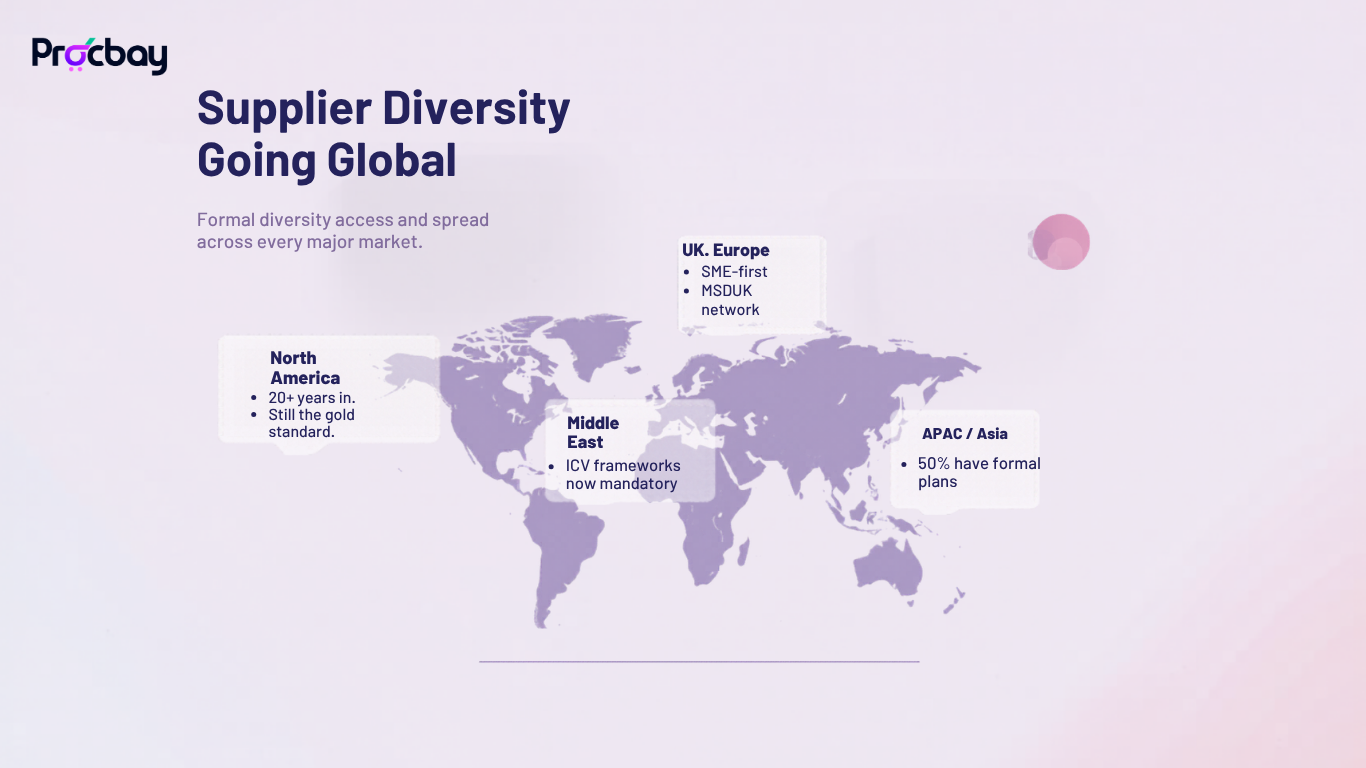
Regional Nuances in Implementation
In Europe and the UK, the focus often shifts toward Small and Medium Enterprises (SMEs) and social value. Organizations like MSDUK are instrumental in connecting ethnic minority businesses with global brands, but the approach is heavily influenced by local community inclusion rather than just ownership percentages.
While programs in North America are well-established, the rest of the world is catching up fast. Data from Veridion’s 2025 ESG Analysis shows that half of the top companies in APAC and Latin America now have formal diversity plans. In the Middle East and Africa, that number is around 38%.
In the Asia-Pacific region, this shift is increasingly driven by what Accenture and WEConnect International (2025) call the “Diversity Dividend”. This research shows that a mere 5% increase in women’s representation in supplier leadership correlates with a 2.2 percentage point rise in corporate revenue growth. Meanwhile, in the Middle East, the approach has moved from voluntary to mandatory through In-Country Value (ICV) frameworks.
The Role of ESG and Regulation
This global expansion is being powered by the rapid adoption of ESG (Environmental, Social, and Governance) reporting frameworks. Global standards such as the Global Reporting Initiative (GRI 204) now explicitly require companies to document their local economic impact and the diversity of their spends. This regulatory pressure, combined with the advocacy of networks like WEConnect International, is forcing a shift in how multinational firms vet their partners.
Moving Beyond the Traditional Business Supplier Model
Traditional procurement is often paralyzed by what we call “incumbent bias.” When an enterprise relies on a single massive business supplier for years, a sense of loyalty develops that can cloud commercial judgment. While this loyalty is often framed as “relationship management,” it frequently creates a monopolistic environment where the incumbent vendor has little incentive to innovate or lower costs.
By contrast, supplier diversity led procurement acts as a forced-intervention mechanism. It requires procurement officers to look past established loyalties and evaluate new, qualified competitors. This doesn’t mean abandoning long-term partners; rather, it means introducing healthy competition into the Request for Proposal (RFP) process.
Did You Know?
Prioritizing supplier diversity can lead to a 20% reduction in overall buying operations costs.
According to research from Procurement Tactics (2025), the introduction of new, agile competitors into the bidding process effectively disrupts legacy “soft monopolies,” forcing incumbents to sharpen their pricing and driving down the total cost of goods and services.
Supply Chain Resilience: Breaking the Concentration Risk
In 2026, the most compelling argument for diversity is resilience. Traditional consolidation creates hidden bottlenecks; often, several Tier 1 suppliers secretly rely on the same Tier 2 or Tier 3 source. By intentionally diversifying the vendor pool, companies introduce separate supply chains, effectively de-risking their operations.
Companies like Ernst & Young (EY) have embraced this shift, spending over $400 million with diverse suppliers, representing roughly 12% of their total procurement spend. This strategy acknowledges that a diversified supply base is inherently more competitive than one locked into a handful of legacy contracts.
Leveraging Small Business Suppliers for Greater Agility
One of the most immediate benefits of working with small business suppliers is the injection of agility into the supply chain. Massive corporate vendors often struggle with layers of bureaucracy that slow down prototyping and execution. In contrast, smaller, diverse-owned firms are typically leaner and more motivated to co-innovate with their enterprise clients.
This “innovation premium” is a primary reason why the healthcare sector (72%) and technology sector (50%) lead the way in diversity adoption. (2022 Fortune Global 500 report: How Global Companies Are Implementing Supplier Diversity Policies)
When a company partners with a small, minority-owned firm, they aren’t just buying a service; they are often gaining a partner that can pivot overnight to solve a specific technical headache or market challenge.
Building a Scalable and Impactful Supplier Diversity Program
For many organizations, the hurdle isn’t the why, but the how. Transitioning to a mature supplier diversity program requires a move away from manual spreadsheets toward automated supplier diversity management.
The Role of AI in Diversity Tools
Modern supplier diversity tools, such as those offered by ProcBay, provide the orchestration layer needed to scale. For instance, an AI-powered Supplier Onboarding & KYC Agent can automatically verify a vendor’s diversity status and ESG metrics during registration, ensuring that compliance isn’t a bottleneck.
Furthermore, Supplier Information Management (SIM) platforms allow procurement teams to maintain a “golden record” of diverse partners, enriched with real-time performance KPIs. This removes the guesswork from supplier diversity procurement, allowing managers to use a Supplier Recommendation Agent to match project requirements with the best-qualified diverse firms in the market.
Corporate Leadership and Benchmarking
The best supplier diversity programs are those that have secured executive buy-in. Procter & Gamble (P&G) is a prime example, having surpassed $3 billion in diverse procurement spending with a clear target of $5 billion annually by 2030. By setting measurable KPIs, for e.g.: mandating that 10% of RFP (Request for Proposal) invitees be from diverse backgrounds, enterprises can add a necessary nuance to their Strategic Procurement Process.
Conclusion: The Competitive Future of Inclusive Sourcing
The traditional procurement is coming to a close ending. As the global supply chain faces increasing scrutiny from investors, regulators, and consumers, the companies that thrive will be those that embrace the mechanical advantages of diversity. By breaking the cycle of incumbent bias and leveraging the agility of small business suppliers, organizations can build a network that is not only more inclusive but significantly more profitable.
Transitioning toward a more inclusive global framework is a continuous evolution, not a one-time project. If the administrative complexity of vetting and onboarding has been the primary barrier to your program’s growth, exploring a more streamlined approach to sourcing might be the next logical step for your team.
Frequently Asked Questions (FAQ)
Q: What is supplier diversity and why is it important in 2026?
A: Supplier diversity is a business strategy of sourcing from the businesses owned by underrepresented groups. In 2026, it is critical because it drives competitive tension, reduces “incumbent bias,” and meets the high transparency standards required by modern ESG regulations.
Q: What are the main benefits of a supplier diversity program?
A: Beyond social impact, a formal program increases ROI by up to 133% (Source: The Hackett Group), boosts innovation output by 33%, and provides access to new, agile markets that traditional “mega-vendors” cannot reach.
Q: How do you qualify as a diverse business supplier?
A: To qualify, a business must typically be at least 51% owned, operated, and controlled by individuals from an underrepresented group. Verification usually requires certification from third-party bodies like the NMSDC or WEConnect International.
Q: How does global supplier diversity differ from domestic (US) programs?
A: While the US focuses on specific ownership certifications, global supplier diversity requires localized strategies. For example, the UK emphasizes SMEs and ethnic minorities through MSDUK, while other regions may focus on indigenous populations or community-based social value.
Q: What roles do supplier diversity tools play in modern procurement?
A: Modern supplier diversity tools automate the discovery and vetting of vendors. They allow enterprises to track Tier 1 and Tier 2 spends accurately across different global jurisdictions while ensuring all partners meet strict data privacy and ESG requirements.
Author

Harsh Singhi is a procurement automation SaaS professional with 8 years of experience helping businesses get more value from digital procurement platforms by streamlining procurement workflows, improving vendor collaboration, and simplifying purchasing processes. He writes about practical, technology-driven approaches to improving business efficiency and driving user adoption by aligning technology with real business needs.
Related Articles

Importance of Stakeholders in Procurement Strategy
Summary A procurement strategy is only as effective as the alignment behind it. In a complex global market, a deal...
Read more
Supply Chain Vendor Management: Strategies to Improve Supplier Performance
Summary Supply chain vendor management is the process of managing vendors that supply goods or services across the supply chain. It...
Read more
How to Choose the Right Vendor Management System for Your Business
Summary A Vendor Management System (VMS) is software that helps businesses manage vendor onboarding, contracts, performance tracking,...
Read more