
Harsh Singhi
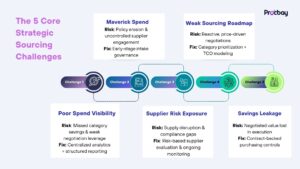
Strategic sourcing challenges arise when procurement teams lack clear spend visibility, structured stakeholder alignment, disciplined supplier evaluation, and contract-backed purchasing controls. When these fundamentals are weak, negotiated savings fail to translate into measurable business impact.
The most common barriers include:
- Limited category-level insight
- Unmanaged intake leading to maverick spend
- Global supplier exposure
- Absence of a structured sourcing roadmap
- Savings leakage after award
In this guide, we examine why sourcing initiatives fail in execution and how procurement leaders can strengthen governance across the procurement lifecycle.
Did You Know?
Strategic sourcing initiatives often break down not at the negotiation stage, but in the gap between supplier selection and purchasing execution.
Why Strategic Sourcing Fails in Execution
Strategic sourcing is designed to improve cost predictability, reduce supplier risk, and strengthen long-term category control. Yet in many organizations, sourcing operates as an isolated negotiation activity rather than a structured, repeatable discipline within the broader strategic procurement process.
The failure rarely sits in the sourcing event itself. It appears in the disconnect between:
- Intake and evaluation
- Supplier selection and contract governance
- Contract award and purchasing execution
- Negotiated savings and realized value
When sourcing decisions are not embedded into operational workflows, financial impact erodes quickly.
Strategic sourcing succeeds only when execution discipline matches analytical rigor.
Simplify Procurement. Accelerate Growth.
Procbay’s AI streamlines requests, approvals, and vendors, so you save time and scale faster.
1. Poor Spend Visibility Limits Category Strategy
A strategic sourcing plan depends on accurate, structured spend data. However, fragmented systems, inconsistent supplier naming, and decentralized purchasing often distort visibility.
When spend insight is weak:
- Category prioritization becomes reactive
- Supplier consolidation opportunities are missed
- Benchmarking leverage declines
- Savings validation becomes difficult
Without reliable analytics, procurement teams negotiate without full context. Strengthening visibility through real-time spend visibility reduces blind spots and improves category decision-making.
Strategic sourcing begins with clarity,not cost pressure.
How to Overcome It
- Standardize supplier and category taxonomy
- Centralize procurement intake channels
- Conduct recurring spend analysis reviews
- Align sourcing waves to high-impact categories
Strong analytics form the foundation of strategic decision-making, supported by consistent application of procurement analytics best practices.
2. Unmanaged Intake and Maverick Spend
One of the most persistent strategic sourcing challenges is stakeholder bypass.
When business users engage suppliers before procurement involvement, raise urgent purchase requests, or renew contracts without competitive review, sourcing loses leverage.
Unmanaged intake creates maverick spend, which undermines compliance and weakens negotiating power.
How to Overcome It
- Introduce structured intake workflows
- Define sourcing thresholds for competitive events
- Route category-based approvals
- Link sourcing outcomes directly to purchasing controls
Strategic sourcing must begin before supplier selection not after. Governance models such as guided intake workflows help ensure procurement involvement early in the decision cycle.
3. Supplier Risk and Global Exposure
Cost optimization often overshadows risk discipline. As supply chains globalize, exposure increases across regulatory, geopolitical, financial, and operational dimensions.
Common risk factors include:
- Political instability
- Regulatory compliance gaps
- Currency volatility
- Logistics disruption
- ESG exposure
- Quality variability
Selecting suppliers primarily on price creates long-term vulnerability. Embedding risk-adjusted evaluation within structured supplier lifecycle management improves continuity beyond supplier selection.
Supplier oversight must continue beyond onboarding. Continuous monitoring and performance reviews are essential to maintaining resilience.
Strategic sourcing is not simply about selecting the lowest-cost vendor it is about selecting the most sustainable partner.
How to Overcome It
- Embed risk scoring into RFP criteria
- Diversify suppliers geographically
- Include compliance and ESG validation
- Tie contracts to measurable performance indicators
- Monitor supplier performance continuously
Supplier risk governance must extend beyond onboarding and remain active throughout the relationship. This structured oversight aligns with a comprehensive supplier lifecycle management framework
4. Absence of a Structured Sourcing Plan
Many procurement teams run sourcing events without maintaining a formal roadmap. Without structured planning, sourcing becomes reactive and price-focused.
Symptoms of weak planning include:
- No category prioritization cadence
- Limited total cost of ownership (TCO) modeling
- Irregular market intelligence
- Lack of post-award governance
A mature sourcing approach requires continuity, not episodic negotiations.
How to Overcome It
An effective strategic sourcing plan should include:
- Category prioritization
- Market analysis
- Competitive event design
- TCO evaluation
- Contract integration
- Supplier performance tracking
Strategic sourcing is cyclical, it does not end at contract signature. Long-term effectiveness depends on alignment with a clearly defined procurement category strategy.
5. Savings Leakage After Award
One of the most overlooked sourcing problems is value erosion after negotiation. Savings often disappear during execution.
Leakage occurs when:
- Buyers purchase off-contract
- Catalogs are not aligned with awarded terms
- Purchase orders bypass negotiated pricing
- Compliance checks are manual
When sourcing systems are disconnected from purchasing, enforcement weakens.
How to Overcome It
- Connect sourcing awards to digital catalogs
- Enforce contract-backed ordering
- Automate compliance validation at PO creation
- Track negotiated vs. realized savings
Savings protection requires lifecycle integration from intake through ordering, often supported by a structured intake-to-order process.
Simplify Procurement. Accelerate Growth.
Procbay’s AI streamlines requests, approvals, and vendors, so you save time and scale faster.
Operational Summary
| Challenge | Risk | Structural Fix | |
| Poor spend visibility | Missed category opportunity | Centralized analytics | |
| Maverick spend | Compliance erosion | Intake governance | |
| Supplier exposure | Supply disruption | Risk-based evaluation | |
| Weak planning | Reactive negotiation | Category roadmap | |
| Savings leakage | Lost financial value | Contract-backed purchasing | |
| “World-class procurement organizations treat strategic sourcing as a continuous discipline, not a periodic event.” | |||
| The Hackett Group, Procurement Benchmarking Research | |||
Final Perspective
Strategic sourcing challenges are rarely analytical failures. They are operational disconnects.
Organizations that sustain sourcing performance:
- Control intake before engagement
- Centralize spend visibility
- Embed supplier risk into evaluation
- Formalize category planning
- Enforce contract-backed purchasing
Strategic sourcing succeeds when governance spans the entire procurement lifecycle, not just the negotiation stage.
Modern procurement platforms such as Procbay are designed to support this lifecycle discipline, connecting intake, sourcing, supplier governance, and contract-backed ordering within a unified operating model.
Strategic sourcing delivers sustained value only when execution is structured, controlled, and continuously monitored.
FAQs
Q: What are the biggest strategic sourcing challenges?
A: The most common challenges include limited spend visibility, stakeholder bypass, supplier risk exposure, lack of structured planning, and savings leakage after award.
Q: Why do sourcing initiatives fail to deliver savings?
A: Savings often fail when sourcing outcomes are not connected to contract enforcement and purchasing controls.
Q: What should a strategic sourcing plan include?
A: It should include category prioritization, market analysis, competitive event design, TCO modeling, contract integration, and supplier performance monitoring.
Q: How can procurement reduce supplier risk?
A: By embedding risk scoring into evaluation criteria, diversifying suppliers, enforcing compliance checks, and monitoring performance continuously.
Related Articles
Strategic Sourcing vs Tactical Sourcing: Key Differences
Procurement leaders today face a dual challenge. They must deliver immediate cost control while building long-term supplier...
Read more
Boost Efficiency with Workflow Agents in Business
Summary: As procurement operations expand, the number of approval layers, supplier checks, and compliance requirements also increases....
Read more
Strategic Procurement Process: Step‑by‑Step Guide
Summary A properly organized strategic procurement process integrates procurement with business objectives, cuts costs, and builds better...
Read more