Harsh Singhi
Summary:
When sourcing is managed through disconnected spreadsheets and email threads, procurement teams lose critical negotiation leverage and administrative hours. This post breaks down how a governed eSourcing strategy replaces manual RFx bottlenecks with structured bid analysis and dynamic price discovery. You will learn the specific mechanisms from automated bid parity to reverse auctions that compress sourcing cycle times and deliver hard bottom-line savings.
When a category manager launches a complex RFx via email, margin begins leaking before the first supplier even responds.
Scattered attachments, unstructured pricing formats, and fragmented communication make true apples-to-apples bid parity nearly impossible. By the time the procurement team consolidates the data into a master spreadsheet, the event has consumed weeks of administrative effort. The team is too exhausted to negotiate strategically, leading to incumbent bias and suboptimal awarding.
If your procurement function is still treating the sourcing event as an administrative document exchange, you are leaving commercial value on the table. Moving to a structured eSourcing strategy changes the underlying mechanics of how enterprise purchasing happens. It replaces manual data entry with market-driven price discovery.
The Hidden Costs of the “Email-and-Excel” RFx
Manual sourcing is defined by friction. When suppliers submit pricing in varying formats, procurement managers spend days normalizing the data. This delay directly impacts the bottom line by extending the sourcing lifecycle and delaying the realization of negotiated savings.
Furthermore, lack of centralized event governance makes it difficult to track supplier behavior over time. If a supplier consistently bids high but drops their price 15% during final negotiations, a manual system rarely flags this pattern for future events. The buyer enters the next negotiation blind.
41% of Chief Procurement Officers cite “inadequate technologies and conflicting priorities”as their primary barriers to improvement, making it the number one operational roadblock in procurement today.
When teams are burdened by fragmented email threads and manual data normalization, they simply lack the capacity to execute strategic sourcing automation and realize targeted cost avoidance.
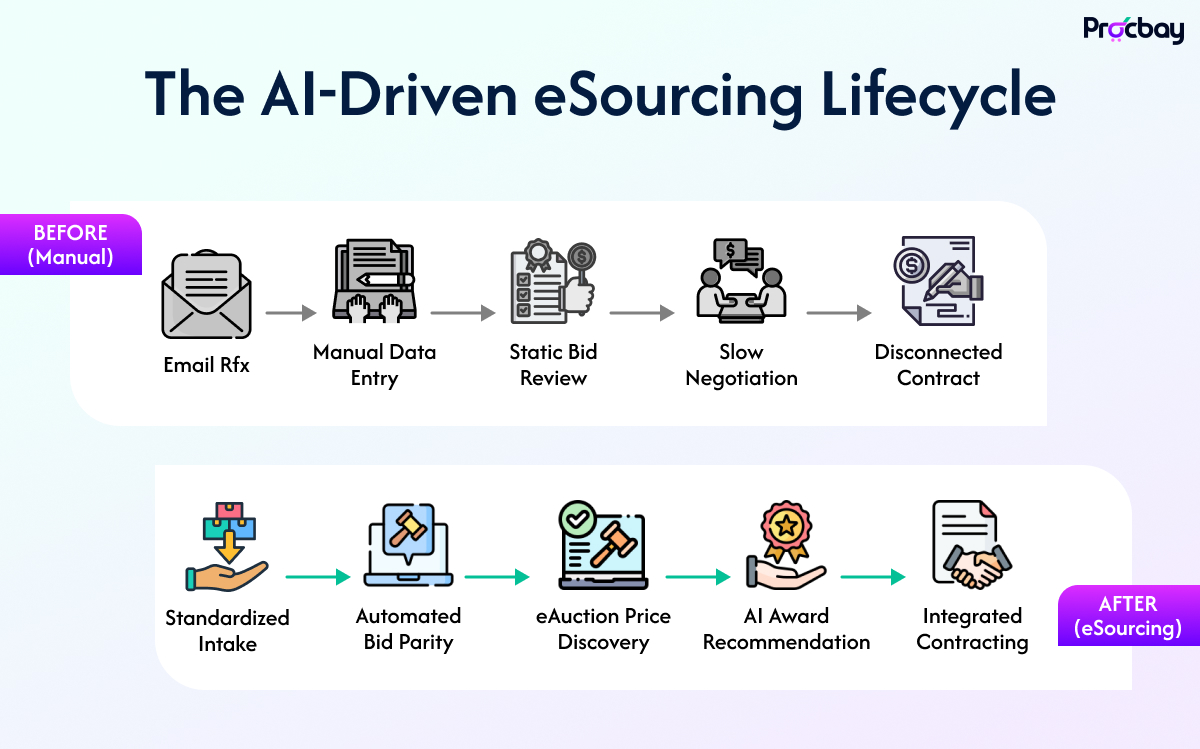
An intelligent eSourcing strategy forces structural discipline. It requires suppliers to submit pricing, technical specifications, and compliance data into a uniform environment. This instantly creates bid parity, removing the 48-hour “spreadsheet marathon” previously required just to establish a baseline.

How eSourcing Compresses Total Cost of Ownership (TCO)
The lowest initial bid is rarely the most cost-effective option once freight, payment terms, and risk premiums are factored in. A major advantage of eSourcing platforms is the ability to run automated, multi-variable bid analysis.
Instead of evaluating a flat unit price, buyers can configure the event to calculate the Total Cost of Ownership (TCO) in real-time. This helps clarify how eSourcing reduces supplier costs over the long term, rather than just securing a temporary discount.
Manual Sourcing vs. eSourcing Strategy
| Evaluation Metric | Email/Spreadsheet RFx | Governed eSourcing Strategy |
| Bid Normalization | Manual copy-pasting; high error risk. | Automated parity upon submission. |
| Price Discovery | Static; limited to 2-3 negotiation rounds. | Dynamic via eAuctions; market-driven. |
| Cycle Time | 4 to 8 weeks average. | 1 to 3 weeks average. |
| Award Logic | Instinct-based or price-only focus. | TCO-driven with weighted technical scores. |
Transitioning away from familiar manual processes naturally surfaces internal friction, and procurement leaders must proactively address strategic sourcing challenges, such as poor data hygiene and stakeholder resistance, to ensure that user adoption doesn’t bottleneck the platform’s ROI.
Beyond the Bid: Real-Time Price Discovery
Static RFQs inherently limit cost reduction in procurement. A supplier provides their initial pricing based on what they believe they need to win, leaving an unknown margin buffer intact.
Deploying the eAuctions Hub as part of your eSourcing strategy introduces dynamic market tension. In a reverse auction, qualified suppliers compete in real-time, driving prices down to their true market floor. This mechanism shifts the leverage entirely to the buyer.
Did You Know?
Organizations that implement advanced sourcing optimization and automated eAuctions can drive incremental cost savings of up to 25% on competitively bid categories, generating near-instant ROI compared to static spreadsheet-based negotiations.
(Source: Gartner — Market Guide for Sourcing Applications, 2025)
eAuctions are not appropriate for every category. They require highly specified technical requirements and a competitive supplier pool. However, when applied correctly to commoditized goods or standardized logistics routes, the ROI of eSourcing platforms for enterprise organizations becomes undeniable.
The AI Layer: Automating the Bid Analysis Bottleneck
Even within digitized systems, analyzing complex supplier proposals across dozens of line items requires heavy analytical lifting. This is where agentic AI reshapes the sourcing workflow.
Using a tool like the Bid Analysis Agent, procurement teams no longer have to manually build pivot tables to find the optimal award scenario. The AI evaluates the submitted bids against historical pricing, risk scores, and available budgets. It then presents the category manager with optimal awarding recommendations in seconds.
A case study: eSourcing in Action
Consider the findings from a recent McKinsey & Company analysis on procurement transformation: when organizations move away from isolated, tactical purchasing and instead align on a cross-category, technology-enabled sourcing strategy, they can achieve an ambitious target of up to 20% in overall savings. For a mid-sized manufacturer sourcing $40M annually, replacing manual spreadsheet analysis with a structured eSourcing process turns weeks of administrative delay into hard margin improvement.
Governance as a Continuous Savings Driver
Procurement cost savings are only valuable if they are realized in the final contract and adhered to during purchasing. An eSourcing strategy ensures that the data generated during the RFx flows directly into the contract authoring phase.
This eliminates “contract leakage”; the margin lost when negotiated terms are incorrectly translated into the final Master Services Agreement (MSA). When sourcing, contracting, and purchasing are orchestrated through a single data model, maverick spend plummets.
| “Purchasing must become supply management… The purchasing portfolio requires a strategic approach, not just an administrative one.”
— Peter Kraljic, HBR (Strategic Purchasing Classic) |
| Source: Harvard Business Review |
To ensure this governance extends throughout the entire life of the supplier relationship, your eSourcing strategy must align cleanly with your broader technology stack. This is why choosing the right vendor management system is critical for preventing data silos and ensuring that the terms negotiated during the RFx are actually enforced during vendor onboarding and performance tracking.
A 2023 The Hackett Group’s press release states, Digital World Class procurement organizations now operate at a 21% lower cost than their peers and do so with 32% fewer staff. This efficiency and the resulting $6 million annual cost advantage for a typical enterprise is the direct result of replacing manual RFx administration with intelligent, technology-enabled event orchestration.
Conclusion
Executing a profitable sourcing event requires more than just subject matter expertise; it requires process velocity. Relying on spreadsheets and email limits the amount of spend a category manager can competitively source in a year.
A comprehensive eSourcing strategy strips the administrative friction. By forcing bid parity, enabling dynamic price discovery through eAuctions, and utilizing AI for instant scenario analysis, procurement teams can source more categories, more frequently. Moving away from manual RFx processes is a fundamental requirement for protecting enterprise margins.
If your team is evaluating how to bring AI-governed structure to your sourcing events and eliminate manual bid comparison, contact us, we will give a 30-minute platform walkthrough and see what that looks like in practice.
FAQ
Q: What is the difference between an RFQ and an eAuction?
A: An RFQ (Request for Quotation) is a static process where suppliers submit their pricing once, usually without knowing where they stand competitively. An eAuction is a dynamic, real-time event where suppliers can actively adjust their pricing downward to win the business based on visible market tension.
Q: How does an eSourcing strategy impact supplier relationships?
A: While some fear eSourcing is too aggressive, it actually improves transparency. Suppliers appreciate standardized requirements, faster evaluation cycles, and the clear, objective feedback that structured eSourcing platforms provide, rather than losing bids in a black-box email process.
Q: What categories are best suited for reverse auctions?
A: Reverse auctions work best for highly specified, commoditized goods or services where the primary differentiator is price. Common categories include standardized packaging, IT hardware, raw materials, freight lanes, and MRO (Maintenance, Repair, and Operations) supplies.
Q: How do you measure the ROI of an eSourcing strategy?
A: The most direct metric is negotiated cost savings compared to historical baselines or market indexes. However, true ROI must also factor in the reduction in sourcing cycle times and the percentage of unmanaged spend brought under governance. By tracking both hard dollar savings and administrative hours recovered, procurement leaders can prove the full commercial impact of the platform.
Q: How does eSourcing reduce maverick spend?
A: Maverick spend occurs when employees bypass procurement to buy directly from unvetted suppliers, usually because the official sourcing process is too slow. An eSourcing strategy accelerates the purchasing cycle through intelligent automation, making it faster to use the governed channel than to go around it. Furthermore, integrating eSourcing with your contract intelligence ensures that negotiated rates instantly populate in your purchasing systems, driving compliance by default.
Author

Harsh Singhi is a procurement automation SaaS professional with 8 years of experience helping businesses get more value from digital procurement platforms by streamlining procurement workflows, improving vendor collaboration, and simplifying purchasing processes. He writes about practical, technology-driven approaches to improving business efficiency and driving user adoption by aligning technology with real business needs.
Related Articles

Importance of Stakeholders in Procurement Strategy
Summary A procurement strategy is only as effective as the alignment behind it. In a complex global market, a deal...
Read more
Supplier Diversity in Global Supply Chains
Summary: Supplier diversity is the strategic practice of proactively sourcing goods and services from businesses owned and operated by...
Read more
Supply Chain Vendor Management: Strategies to Improve Supplier Performance
Summary Supply chain vendor management is the process of managing vendors that supply goods or services across the supply chain. It...
Read more