Harsh Singhi
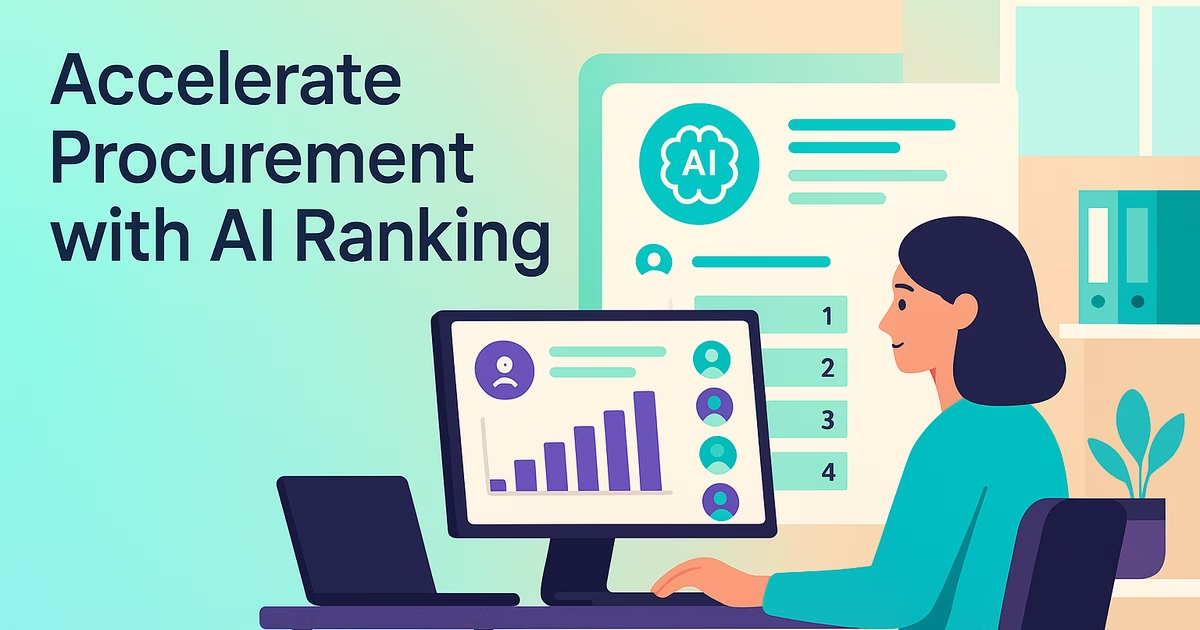
Manual spreadsheets, late-night email chains, and endless debate over what best value really means drain hours and goodwill from every sourcing event. Imagine replacing all that costly friction with data-driven confidence. With the right bid ranking algorithms from Procbay, suppliers can be ranked objectively within seconds, while intelligent bidding systems provide audit-ready accuracy. AI-driven workflows provide real-time insight that uncovers savings opportunities, mitigates risks, and shortens cycle times. In the next ten minutes, you’ll learn how these bid scoring models, intelligent bidding systems, and auction data algorithms work, why they are a must-have in 2025, and the exact playbook top procurement teams follow to deploy them at scale.
The High Cost of Manual and Inefficient Bidding Processes
Shadow purchasing increases as stakeholders lose patience with inefficient processes, while compliance flags pile up when bids are tallied by hand. In addition to the obvious time sink, three hidden costs surface:
- Limited visibility: Disconnected data blinds CFOs to the true total cost of ownership (TCO) and purchase price variance (PPV).
- Inconsistent criteria: Different evaluators apply different weightings, opening significant gaps during audits.
- Slow awards: Prolonged RFx cycles stimulate maverick spending, with business partners going rogue.
These are where manual bid ranking algorithms and manual processes fail the procurement teams, as they simply cannot keep pace with the modern business demand.
Spend Smarter. Grow Faster.
Gain control of expenses and boost efficiency with Procbay.
How Intelligent Bidding Systems and Auction Data Algorithms Deliver Business Impact
When algorithmic scoring replaces manual tabulation, procurement can shift beyond its tactical role to a strategic advisory function. This transition empowers businesses with:
Speed, Savings, and Compliance: The Triple Threat Results
- Accelerated cycle times: Leading platforms can cut award decision time by up to 50%. This is achieved by automating bid score calculations, which frees teams to focus on strategic work.
- Improved savings pipeline: Optimizers that use Mixed-Integer Linear Programming (MILP) uncover savings opportunities traditional Excel models miss so adeptly. Currently, only approximately 20% of average intelligent bidding systems offer this capability.
- Audit-ready transparency: Every weight, adjustment, and supplier response is captured, providing a living audit trail. Finance and Internal Audit can replay it nearly instantaneously.
Traditional Evaluation Criteria vs Algorithmic Process: A Side-By-Side Comparison
Below is a comparison highlighting the differences between manual and algorithmic bidding processes:
| Dimension | Manual Process | Algorithmic Process |
|---|---|---|
| Bid consolidation | Email attachments, copy-pasting | Automated data ingestion pipelines |
| Evaluation criteria | Varies by buyer | Standardized, centrally managed, objective |
| Scenario modeling | Limited to the total price | Unlimited parameters: price, SLA, risk, and CO8 emissions |
| Time to award | 2 6 weeks | 1 2 days for an objectifiable rank position |
| Audit trail | Fragmented and incomplete | Immutable & searchable via AI-driven workflows |
Demystifying Bid Ranking Algorithms
Even the most seasoned Chief Procurement Officers (CPOs) shy away from complex mathematical solutions. So, here’s the plain-English version.
1. Weighted Factor Scoring: The Classic Approach
Each criterion1customizable as per category management needs1such as price, lead time, and quality, is assigned a weight. Suppliers are then ranked based on the composite score. This process is simple, transparent, but static in nature, needing regular review for continuous improvement.
2. Optimization Engines: Linear Programming (LP) and Mixed Integer Linear Programming (MILP)
These engines crunch thousands of award scenarios to minimize cost while respecting capacity limits, Incoterms, and SLA constraints. MILP’s ability to handle binary (yes/no, integer) decisions ensures real-world conditions are captured, leading to better-awarded contracts.
3. Machine Learning Risk Adjusters
Intelligent bidding systems apply random forest or gradient boosting models on top of bid scoring models to identify potential risk factors. These include suspiciously low bid prices, delivery commitments that defy historical performance, or suspicious collusion patterns. NIH research has illuminatively shown how convolutional neural networks can vastly reduce fraud risks in public tenders.
4. Auction Data Algorithms
These specialized routines dynamically update reserve prices, extend bid timers, or automatically invite challenger suppliers based on live bidding behaviors. They balance competitive tension with fair-play principles to prevent unfair bid sniping.
Pro Tip:
Start by implementing weighted scoring for transparency and then introduce optimization and machine learning add-ons once the quality of the input data is proven at scale. This staged approach builds organizational trust and keeps IT integration manageable.
Simplify Procurement. Accelerate Growth.
Procbay’s AI streamlines requests, approvals, and vendors, so you save time and scale faster.
The Procbay Framework: Audit-Ready and Outcome-Driven Scoring
Procbay embeds the four algorithmic tiers outlined above into a unified intake-to-pay workflow, providing unique differentiators, including:
- Unified data fabric: RFx data, supplier master records, and historical P2P transactions all feed into one real-time bid ranking algorithm, avoiding manual data re-entry.
- Transparent rule editor: Procurement teams can directly configure weighting, MILP constraints, or ML risk thresholds, without needing coding support. This ensures that control and ownership remain with the organization’s business teams.
- Continuous learning loop: Every awarded event retrains the entire scoring model, improving forecasting accuracy quarterly.
Evidence from the Field
- Keelvar’s autonomous, AI-driven bidding bots now handle approximately 80% of spot bids, liberating category managers to focus on high-value strategic work.
- Biased or inefficient supplier screenings have been reduced by around 40% in various Spanish public tenders, with Random Forest-based AI optimizers handling more than 100,000 auction data algorithm records.
- Clients using GEP SMART monitor their savings pipeline and cycle times in real time, analyzing auction data to improve contract award decisions.
Risk and Governance: Maintaining Audit Trail Integrity
Algorithmic tools can underperform or backfire without the necessary oversight.
- Bias control: Regularly audit your training data for supplier location, business size, or diversity flags to prevent systemic bias.
- Collusion detection: Leverage pattern recognition algorithms and cross-event model comparisons to detect identical pricing ladders or bid-rotation schemes.
- Policy alignment: Every scoring rule should have a direct tie to an approved corporate sourcing policy. Changes must be logged for at least seven years for compliance reasons.
Watch Out:
Over-optimizing for the lowest price may inadvertently penalize strategic suppliers. Always ensure that your bid ranking algorithms include essential service and resilience metrics to maintain a balanced scoring approach.
Executive Playbook: Operationalizing Smart Bidding in 2025
-
Secure C-Level Sponsorship
Clearly articulate the direct link between bid ranking algorithms and crucial enterprise KPIs like cash flow, EBITDA, and overall risk mitigation.
-
Clean and Centralize Data
Normalize supplier master records, historic purchase order lines, and related contract terms before integrating intelligent bidding systems.
-
Configure the Algorithms
Start with baseline weights, then incrementally add optimization constraints and machine learning risk flags. All changes must be fully documented for audit purposes.
-
Pilot and Benchmark
Run controlled bidding events, capturing key metrics like cycle time and contract savings, and then compare results against manual, non-algorithmic processes.
-
Scale and Iterate
Once proven effective, fully integrate the algorithms with core ERP and P2P systems. Expand their applicability to other spend categories and schedule regular model reviews to periodically incorporate further improvements.
FAQ
Q: What exactly is a bid ranking algorithm in procurement?
A: It is a rules-based, AI-enhanced method that objectively orders supplier bids against multiple weighted business criteria, including price, quality, and risk, delivered within seconds.
Q: How do intelligent bidding systems differ from traditional RFx bidding tools?
A: Intelligent bidding systems embed real-time optimization, dynamic scenario modeling, and machine-learning risk checks. They eliminate the need for time-consuming manual analysis.
Q: How can I ensure transparency and auditability in these systems?
A: Use procurement platforms that log every weight change, model update, and user action into a secure, immutable audit trail. These logs should be exportable as formal compliance reports.
Q: Can these intelligent bidding systems completely replace human judgment?
A: Not at all. While these tools massively accelerate data processing and scenario modeling, final decision-making and strategic trade-offs1like innovation and partnership potential1remain the domain of human experts.
Next Steps
Ready to reclaim lost work hours, slash rogue spending, and equip Finance with clear audit trails? Schedule a 30-minute strategy session with a Procbay solution architect. They will demonstrate your own RFx bid data ranked in real time using advanced bid ranking algorithms. The goal is to prepare you before your next approval cycle.
Within just a few months, you’ll refer to bid ranking algorithms as naturally as you do three-way matching. And you will genuinely wonder how your procurement team ever managed to process meaningful bids without these AI-driven workflows.
Related Articles
Strategic Sourcing vs Tactical Sourcing: Key Differences
Procurement leaders today face a dual challenge. They must deliver immediate cost control while building long-term supplier...
Read more
Boost Efficiency with Workflow Agents in Business
Summary: As procurement operations expand, the number of approval layers, supplier checks, and compliance requirements also increases....
Read more
Strategic Procurement Process: Step‑by‑Step Guide
Summary A properly organized strategic procurement process integrates procurement with business objectives, cuts costs, and builds better...
Read more