Intake Workflow Agent
AI workflow agent for governed intake and routing
Procbay’s Intake Workflow Agent sits in front of your existing systems, classifies every business request, and auto-routes it to the right sourcing, contract, or catalogue flow-so CIOs and CFOs get control, speed, and financial discipline without adding headcount.
What Is the Intake Workflow Agent?
The Intake Workflow Agent is an AI-powered decision engine that serves as the single, intelligent control point between your procurement intake channels (email, chat, forms, ITSM, ERPs) and your execution systems (Sourcing, CLM, P2P, ITSM).
For every incoming request, the Agent automatically:
Understands
Classifies the request (category, entity, risk, value) regardless of the source.
Decides
Determines the single best workflow: sourcing, contract, catalog, or exception path.
Governs
Applies your strict financial and policy rules (DOA, budgets, thresholds).
Orchestrates
Pushes it into the right execution system (acting as a modern requisition software) with the correct approvers.
Key Value Pillars for CIOs & CFOs
Policy-Aware Routing, Every Time
Automatically routes requests based on category, value, entity, and risk—eliminating human error and ensuring the right workflow is chosen instantly through automated requisition.
Embedded Financial Governance
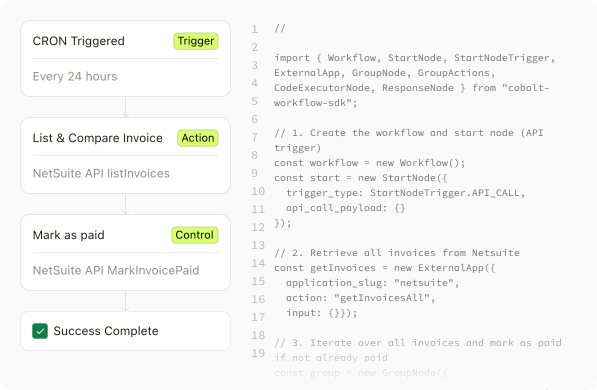
Enforce DOA, budget ownership, and contract coverage now of routing, drastically reducing off-policy spend and preventing late-stage escalations in the purchase requisition process.
From Noise to Structured Insight
Converts chaotic free-text emails, tickets, and chat messages into structured, analytic-ready data (category, cost center, entity, risk score) for accurate forecasting and reporting.
Strategic Focus for Core Teams
Removes repetitive triage, classification, and approval selection from IT, Procurement, and Finance, freeing teams to focus on vendor strategy, risk management, and cost optimization.
Scale Global Compliance
Centralize core policy logic while allowing specific local variations by entity or region, enabling compliant growth without multiplying operational complexity.
How the Agent Operates
Listens Across All Channels
- The Agent listens for requests from all channels (ERP, ITSM, Email, Chat, purchase request form entries) to unify intake without forcing users into a new portal.
Understands & Classifies Demand
- Uses AI to identify the request’s category, entity, requester context, and risk profile based on all available data.
Decides the Route Under Your Policies
- The policy-aware engine applies your DOA, approval rules, and category policies to decide the optimal route and select the correct approvers automatically.
Orchestrates Handoffs & Visibility
- Pushes the request into the target system, tracks the SLA, and updates a central dashboard, providing 100% auditable visibility across all departments.
Inside the AI Brain: Agent Capabilities
Multi-Signal Classification Engine
Reads line items, free descriptions, supplier history, and requester context to classify requests with higher consistency than traditional rule-based systems.
Policy-Aware Routing Logic
Uniquely combines machine learning with your human-defined DOA matrices and financial policies to ensure routing is both optimized and compliant.
Smart Recommendations & Auto-Approvals
Suggests best-fit actions and performs conditional auto-approvals for low-value, low-risk requests based on defined thresholds.
Continuous Learning with Oversight
Improves classification accuracy and routing decisions over time by learning from human overrides and outcome data while maintaining transparency.

Risk & Anomaly Detection
Instantly flags unusual patterns (split POs, high-risk suppliers) and routes them into an enhanced human review workflow.
Human-in-the-Loop Governance
The Agent accelerates decisions while ensuring your governance rules always hold primary authority.
Explainable Decisions
Every routing decision and classification score is logged and visible. Procurement, Finance, and IT can instantly see why the Agent chose a specific route or approver.
Policy Hierarchy is King
AI recommendations are secondary to your defined rules (DOA, thresholds, preferred suppliers). If a policy conflicts with an AI suggestion, the policy always prevails.
Full Override Capability
Procurement and Finance teams retain the ability to override any AI suggestion or classification, ensuring a human-in-the-loop governance model for complex or exceptional scenarios.
Verifiable Financial & Operational Outcomes
40–60% Reduction in time spent triaging and routing requests for streamlined requisition management.
Streamline your requisition management process with automated triage and intelligent routing.
20–30% Faster cycle time from request to PO or contract signature.
Accelerate procurement cycles with faster processing from initial request to final approval.
10–20% Uplift in on-contract and policy-compliant spend.
Increase compliance and maximize value through better contract utilization and policy adherence.
50–70% Fewer routing and approval errors.
Minimize errors and improve accuracy in routing and approval processes.
Up to +30 pts improvement in SLA adherence across systems and teams.
Achieve significant improvements in service level agreement compliance across your organization.
100% Auditable and verifiable routing decisions.
Ensure complete transparency and accountability with fully auditable routing decisions.
Procbay Agent vs. Legacy Workflows
See how Procbay Intake & Demand Capture compares to legacy solutions
| Feature / Capability | Procbay Intake Workflow
Agent | Legacy Workflows / Manual
Routing |
|---|---|---|
| Classification Engine | ML + rules across category,
entity, value, and risk | Static rules or human interpretation |
| Routing Decisions | Policy-aware, AI-augmented, fully
auditable | Hardcoded flows or email forwarding, limited audit |
| Financial Controls | DOA, budgets, and thresholds
embedded in routing | Applied later in P2P or Finance, often after the fact |
| Orchestration | Integrates with ERPs, Sourcing,
CLM, ITSM via APIs | Point-to-point connections or manual handoffs |
| Risk & Anomaly Detection | Built-in risk scoring and
escalation paths | Manual checks or after-the-fact reviews |
| Learning & Optimization | Routing and classification improve
over time | No learning; every change is a manual IT project |
| Time to Value | Pre-built patterns, configurable,
quick to roll out | Long projects to encode complex rules |
FAQs
Browse through our frequently asked questions to find quick answers about ProcBay.
ERP/P2P workflows start after a structured purchase requisition is created. The Agent operates earlier—at the moment a request appears via email, chat, or ITSM—classifying and routing it into the right system before it becomes a PR or ticket.
Yes. Business-friendly configuration screens let Finance, Procurement, and IT manage rules, DOA matrices, and exception paths. IT focuses on integration and governance, not day-to-day rule changes.
Your rules and DOA policies are primary. You can require human review for high-risk items, define strict auto-approval boundaries, run the agent in shadow mode, and log all decisions for complete review.
Yes. The Agent detects the correct entity/region from the request and applies the corresponding, highly tailored rules, approvers, and thresholds automatically.
Dashboards show request volumes, cycle times, SLA adherence, policy overrides, and exceptions—broken down by entity, region, and category—to identify bottlenecks and risk quickly.