Every finance and procurement team has lived at this moment: an invoice arrives; the PO looks “close enough,” the GRN is missing (or wrong), and suddenly a simple payment turns into a week of follow-ups.
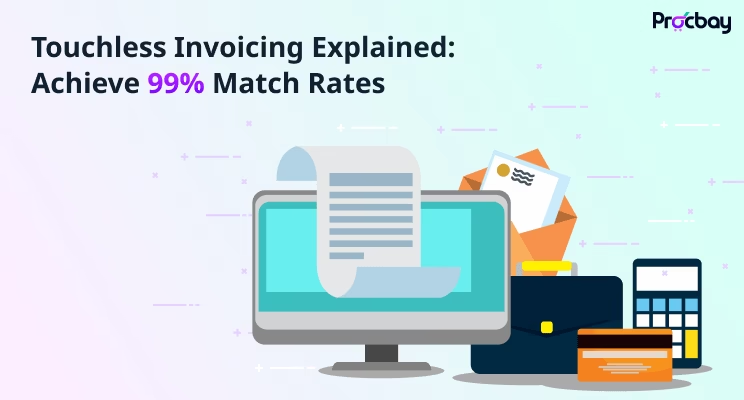
That is fixed via touchless invoicing. It is the process of processing bills with the least amount of human involvement possible because everything is automatically validated by the system.
This blog will describe touchless invoicing, demonstrate the operation of three-way match automation, and offer a workable strategy for achieving 99% match rates without causing chaos in Finance, Procurement, and AP.
What is touchless invoicing?
Touchless invoicing refers to invoices getting verified and approved automatically without manual back-and-forth, as the data already matches your rules.
The engine behind this is invoice verification automation: it checks whether the invoice aligns with what you ordered (PO) and what you received (GRN/service confirmation). When implemented correctly, it minimizes invoice discrepancies, speeds up the approval process, and safeguards cash flow.
Why “99% match rates” is a goal (and what it really means)
A “99% match rate” doesn’t imply that each invoice is perfect; rather, it indicates that the majority of invoices comply with your matching criteria, allowing only the genuine exceptions to require human review. In practical terms, better match rates mean:
- fewer payment delays
- fewer supplier disputes
- faster month-end close
- stronger audit trails
And yes – touchless invoicing is among the quickest methods to enhance business process efficiency in procurement and finance.

Three-way match automation: the core of touchless invoicing
Three-way match automation compares three records:
1) Purchase Order (what you agreed to buy)
2) Goods Receipt / Service Confirmation (what you actually received)
3) Supplier Invoice (what you’re being billed)
When these align within your tolerance rules, the invoice auto-approves. When they don’t, the system routes it into invoice exception management with the right owner and context.
That’s why matching automation software matters it doesn’t just match; it applies policy, tolerances, tax rules, and approval paths.
Where touchless invoicing breaks (common causes of mismatches)
Most mismatches come from a handful of predictable gaps:
• PO not created (or created after the invoice)
• receiving not recorded on time
• price/quantity variance beyond tolerance
• unit-of-measure differences
• incorrect supplier master data
• tax/charges not aligned to the PO
This is why supplier information management and complete vendor profiles are critical. Bad supplier data creates “false exceptions” that waste time.
Quick table: common mismatches and what automation does
Below is a quick “Excel-style” view of the most common invoice issues and how automation resolves them.
| Mismatch type | Common root cause | Automation fix | Owner (typical) |
| No PO / late PO | Invoice arrives before PO creation | Block or route to create/convert to PO flow; enforce policy gates | Requester / Procurement |
| Missing GRN | Receiving not recorded or delayed | Auto-remind receiving; route to receiver; allow service confirmation workflow | Store/Operations / Requester |
| Price variance | Supplier price differs from PO/contract | Tolerance rules; auto-route to buyer; update PO or dispute | Buyer / Procurement |
| Qty variance | Partial delivery or incorrect receipt | Match to received qty; hold remainder; route to receiving correction | Receiving / AP |
| Tax/charges mismatch | Freight/packing/tax not aligned | Standardize charge codes; auto-validate tax rules; route to AP review | AP / Finance |
| Supplier master data issue | Wrong payment terms/UOM/bank details | Supplier information management validation; required fields; approvals for edits | Vendor Master / Procurement |
| Duplicate invoice | Vendor resubmits or system duplicates | Duplicate detection rules and flags; block payment | AP |
What AP reconciliation tools should do (beyond matching)
Modern AP reconciliation tools shouldn’t stop matching. They should:
• auto-code invoices to the right GL/cost center
• enforce policy and approvals (including multi-level approvals)
• detect duplicates and anomalies
• support e-invoicing compliance when required
• provide audit-ready logs and reporting
When paired with approval workflow visualization, teams can see bottlenecks and fix delays instead of guessing.
How to implement automated invoice matching (a practical rollout)
Here’s a simple, low-drama approach to how to implement automated invoice matching:
Step 1: Standardize your rules
Define tolerances (price/qty), required fields, and who owns which exception types.
Step 2: Clean supplier and item data
Improve supplier information management, bank/tax details, payment terms, UOM mapping, and catalogue accuracy.
Step 3: Fix receiving discipline
Make GRN/service confirmation timely. Touchless invoicing dies without reliable receiving.
Step 4: Automate routing and approvals
Route exceptions automatically with context. Enforce multi-level approvals only when needed.
Step 5: Measure and optimize weekly
Track match rate, top exception reasons, and cycle times. Use budget vs. actuals analysis to connect savings to real impact.
Choosing the Best Three-Way Match Automation Solutions: What to Look For
When evaluating the best three-way match automation solutions, focus on capabilities that reduce false exceptions:
• strong invoice verification automation with configurable tolerances
• flexible matching rules (PO, non-PO, services)
• exception workflows with ownership and SLAs
• integrations with ERP, e-invoicing, and procurement
• analytics that show why invoices fail to match
For three-way match automation for finance teams, visibility matters. Combine matching with real-time spend visibility so Finance can forecast cash and liabilities with confidence.
Conclusion
Touchless invoicing is not a ‘nice to have.’ It’s the fastest way to reduce invoice noise, pay suppliers on time, and stop AP from becoming a bottleneck.
With the right three-way match automation, matching automation software, and AP reconciliation tools, you can push routine invoices straight through and focus your team only on the exceptions that truly matter.
Take Next Steps Today
Discover how to reduce invoice exceptions and boost touchless invoicing with a strategy call.
Schedule a 30-minute touchless invoicing and three-way match automation session with Procbay’s solution architects. During this meeting, they will:
• Showcase a live guided demo of invoice verification automation and automated invoice matching
• Share ready-to-use templates for matching rules, tolerances, and exception workflows
• Design a customized ROI model to quantify time saved, faster close, and fewer supplier disputes
FAQs
Q: What is a three-way match automation?
A: Three-way match automation automatically compares the PO, the goods receipt/service confirmation, and the supplier invoice. If they match within tolerance, the invoice can be approved without manual work.
Q: Why do touchless invoicing projects fail?
A: Most fail due to poor supplier data, late receiving/GRNs, unclear tolerance rules, or exception handling that still relies on email and spreadsheets.
Q: Which invoices can be processed touchless?
A: PO-based invoices with consistent pricing, clean supplier master data, and timely receiving are the best candidates. Services can also be touchless if confirmations are done properly.
Q: What should AP reconciliation tools include?
A: Beyond matching, they should support exception workflows, approval controls, duplicate detection, audit trails, and compliance requirements like e-invoicing when applicable.
Q: How do we start improving match rates quickly?
A: Start with the top 5 mismatch causes, standardize tolerances, fix supplier master data, and enforce timely receiving, then automate routing for the remaining exceptions.
Connect with our procurement experts to tailor an AI-governed sourcing strategy for your enterprise.
Contact Us