Procurement leaders today face a dual challenge.
They must deliver immediate cost control while building long-term supplier resilience. Yet many organizations fail to clearly separate transactional purchasing from strategic value creation. The result is fragmented spend, duplicated suppliers, and limited visibility.
Understanding Strategic Sourcing vs Tactical Sourcing: Key Differences is critical for scaling procurement maturity without sacrificing speed.
With the right structure and digital infrastructure, both approaches can coexist, efficiently and compliantly.
What Is Strategic Sourcing?
Strategic sourcing is a long-term, analytical approach to procurement.
It evaluates enterprise-wide spend, supplier performance, market trends, and risk exposure to build structured category strategies. The focus extends beyond price to total cost of ownership, supplier innovation, and long-term stability.
Strategic sourcing operates within a broader strategic procurement process that aligns procurement decisions with financial planning and operational goals.
Core characteristics include:
- Spend analysis and demand forecasting
- Supplier consolidation
- Competitive bidding events
- Contract lifecycle alignment
- Risk and compliance assessment
It is proactive, structured, and data-driven.

What Is Tactical Sourcing?
Tactical sourcing focuses on fulfilling immediate purchasing needs.
It is reactive and transaction-oriented. When departments submit requests, procurement identifies suppliers, negotiates pricing if required, and processes the purchase.
This method prioritizes operational continuity.
Tactical sourcing is typically used for:
- Spot purchases
- Urgent requirements
- Low-value repetitive buys
- Non-core categories
While necessary, overreliance on tactical sourcing limits negotiation leverage and weakens spend control.
Strategic vs Tactical Sourcing: Core Differences
The distinction between strategic vs tactical sourcing becomes clearer when comparing scope, impact, and governance.
Time Horizon
Strategic sourcing focuses on multi-year value creation.
Tactical sourcing addresses immediate needs.
Value Objective
Strategic sourcing optimizes total cost, risk, and supplier performance.
Tactical sourcing ensures operational continuity.
Governance Level
Strategic sourcing requires structured evaluation and executive oversight.
Tactical sourcing follows defined purchasing controls.
Tactical Sourcing vs Strategic Sourcing: A Structural Comparison
The difference is not philosophical. It is operational.
Here’s how both models compare in execution:
Strategic vs Tactical Procurement Model
| Metric | Strategic Sourcing | Tactical Sourcing |
| Time Horizon | Long-Term (Multi-Year) | Short-Term / Immediate |
| Focus | Total Value & Risk Optimization | Speed & Fulfillment |
| Supplier Strategy | Consolidated & Performance-Driven | Transactional & Availability-Based |
| Negotiation Leverage | High | Limited |
| Spend Visibility | Enterprise-Level | Department-Level |
| Compliance Control | Structured & Contract-Aligned | Policy-Based |
This structural clarity defines sustainable procurement maturity.
Financial Impact: Strategic vs Tactical Purchasing
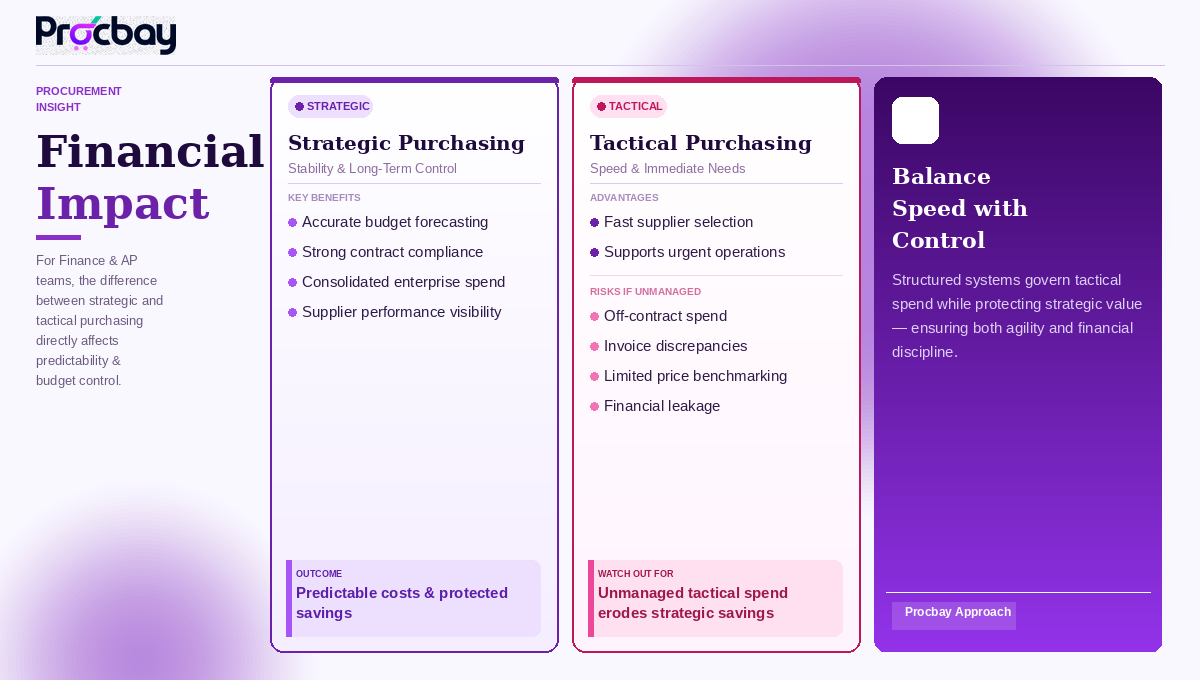
For Finance and AP teams, the difference between strategic vs tactical purchasing directly affects predictability.
Strategic sourcing improves:
- Budget forecasting
- Contract compliance
- Spend consolidation
- Supplier accountability
Because sourcing decisions are structured and contract-backed, strong budget control mechanisms protect negotiated savings and reduce variance.
Tactical Purchasing Prioritizes Speed
Tactical purchasing supports operational continuity when speed is critical.
However, when overused or poorly governed, it can result in:
- Off-contract spend
- Invoice discrepancies
- Limited price benchmarking
- Reactive supplier selection
Without structured oversight, tactical activity increases financial leakage.
Integrated procurement platforms ensure that tactical buying remains policy-controlled while strategic categories receive structured analysis and contract enforcement.
When to Prioritize Strategic Sourcing
Strategic sourcing should be applied to:
- High-spend categories
- Critical suppliers
- Regulated industries
- Long-term service contracts
- Categories with supply risk
Competitive mechanisms such as a structured reverse auction strategy are often embedded within these initiatives to improve price transparency while maintaining governance.
Strategic sourcing builds leverage and resilience.
When Tactical Sourcing Is Appropriate
Tactical sourcing remains necessary for agility.
It works best when:
- Spend value is low
- The supplier base is standardized
- The purchase is urgent
- The category is non-strategic
The key is ensuring tactical activity operates within defined guardrails, not outside them.
The Risk of Tactical Overdependence
Organizations that lean too heavily on tactical procurement experience:
- Supplier duplication
- Inconsistent pricing
- Contract fragmentation
- Compliance gaps
- Reduced negotiation power
This imbalance weakens overall procurement effectiveness.
The solution is not eliminating tactical sourcing ,it is structuring it within a governed framework that supports long-term category strategy.
How Technology Enables Both Approaches
Historically, procurement teams had to choose between speed and structure.
Modern digital platforms eliminate that trade-off.
A unified system enables:
- Structured intake for all requests
- Automated budget validation
- Preferred supplier enforcement
- Integrated contract tracking
- Centralized supplier data
Tactical requests move quickly but remain compliant.
Strategic sourcing events operate within structured workflows, leveraging supplier analytics and performance insights from centralized supplier lifecycle management.
At Procbay, sourcing, approvals, supplier onboarding, and compliance controls operate within one ecosystem. This allows procurement leaders to shift focus from chasing transactions to driving category value.
A Practical 3-Point Alignment Framework
To balance strategic and tactical sourcing effectively:
- Segment Spend Clearly – Define which categories require strategic oversight.
- Automate Tactical Controls – Enforce budget checks and preferred vendor validation systemically.
- Digitize Strategic Events – Manage RFPs, auctions, and contracts within structured workflows.
This ensures speed without compromising governance.
Scaling Procurement Maturity
As organizations grow, procurement complexity increases.
ERP integrations, multi-entity operations, regulatory audits, and supplier risk management demand structured systems , not spreadsheets and emails.
Mid-market and enterprise organizations need:
- Real-time spend visibility
- Controlled approval workflows
- Centralized contract governance
- Supplier performance tracking
- Audit-ready documentation
Balancing tactical vs strategic procurement at scale requires system-driven orchestration.
The Strategic Decision for Leaders
For Procurement and Supply Chain leaders, the objective is not choosing one approach over the other.
Both strategic and tactical sourcing are essential.
The real differentiator is whether your infrastructure:
- Clearly separates category strategy from transactional buying
- Maintains policy control over tactical spend
- Provides enterprise-level visibility
- Connects sourcing decisions with supplier performance
Organizations that succeed treat tactical sourcing as structured execution, not uncontrolled activity.
Moving Toward Structured Procurement
Procurement maturity depends on clarity.
Strategic sourcing drives long-term value. Tactical sourcing maintains operational flow. When both operate within a unified digital framework, organizations gain speed, visibility, and control simultaneously.
Procbay enables this alignment by integrating sourcing workflows, supplier governance, contract oversight, and approval automation into one connected platform.
The result is not just digitized procurement, it is structured procurement.
Looking Ahead
The conversation around Strategic Sourcing vs Tactical Sourcing: Key Differences will continue to evolve as AI-driven analytics, predictive risk monitoring, and automated compliance reshape procurement.
Strategic sourcing will become more predictive.
Tactical sourcing will become more automated and policy-enforced.
The organizations that win will not eliminate tactical buying. They will structure it intelligently and align it with long-term sourcing strategy.
Procurement excellence today is defined by balance, strategy supported by structure, and agility protected by governance.
FAQs: Strategic Sourcing vs Tactical Sourcing
Q: What is the main difference between strategic and tactical sourcing?
A: Strategic sourcing is a long-term, data-driven approach focused on total cost, supplier relationships, and risk management. Tactical sourcing is short-term and transaction-based, focused on fulfilling immediate purchasing needs. The key difference lies in time horizon, value impact, and governance depth.
Q: When should an organization use tactical sourcing instead of strategic sourcing?
A: Tactical sourcing is appropriate for low-value, urgent, or non-critical purchases where speed is more important than long-term supplier optimization. However, it should still operate within defined procurement policies to prevent spend leakage.
Q: Is tactical sourcing less important than strategic sourcing?
A: No. Tactical sourcing is essential for operational continuity. The issue arises when tactical purchasing dominates high-spend or strategic categories. Mature procurement functions balance both approaches within a structured framework.
Q: How does strategic sourcing improve financial performance?
A: Strategic sourcing improves financial outcomes through spend consolidation, contract compliance, supplier performance monitoring, and stronger negotiation leverage. It enhances budget predictability and reduces long-term procurement risk.
Q: What risks come from over-reliance on tactical procurement?
A: Excessive tactical procurement can lead to supplier duplication, inconsistent pricing, off-contract purchases, compliance gaps, and limited visibility into enterprise-wide spend.
Q: Can technology support both strategic and tactical sourcing?
A: Yes. Modern procurement platforms automate tactical controls like budget validation and preferred supplier checks while enabling structured strategic sourcing events such as RFPs, auctions, and contract lifecycle management.
Connect with our procurement experts to tailor an AI-governed sourcing strategy for your enterprise.
Contact Us