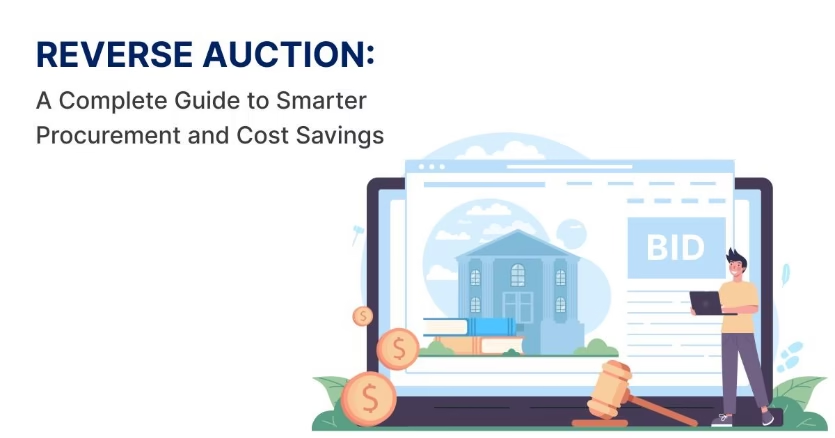
Reverse auctions give procurement teams a structured way to test supplier pricing through competitive, time-bound bidding. For organizations managing large purchasing volumes, they can improve price discovery, shorten negotiations, and provide clearer evidence of how a supplier was selected.
However, the outcome depends on more than the lowest bid. Buyers need accurate specifications, qualified suppliers, clear auction rules, and a reliable method for measuring savings against an approved baseline. This guide explains how reverse auctions work, where they fit within industrial procurement, and what decision-makers should assess before choosing an auction platform. It also examines how Procbay supports controlled bidding, supplier evaluation, and procurement visibility.
What Are Reverse Auctions?
A reverse auction is a competitive sourcing event in which multiple suppliers bid to offer a buyer the most attractive price for a defined requirement. Unlike a traditional auction, where buyers compete to increase their selling price, suppliers in a reverse auction typically compete by reducing their bids.
For example, a manufacturing company purchasing standard steel components can invite qualified vendors to bid during a scheduled online event. Each supplier receives the same specifications and bidding rules. The buyer can then assess competitive prices alongside delivery terms, quality requirements, and other award conditions.
A procurement auction is most effective when requirements are clear, several capable suppliers are available, and price competition can influence the final decision.

Typical applications include:
- Standard industrial components and raw materials.
- Packaging, consumables, and maintenance supplies.
- Freight, logistics, and selected outsourced services.
- Repeat purchases with established specifications.
Types of Reverse Auctions
Different auction formats control how suppliers submit bids and how much pricing information they can see. The right format depends on category complexity, competition, confidentiality requirements, and the buyer’s evaluation policy.
| Auction type | How it works | Suitable application |
| Open-bid auction | Suppliers see permitted competitive bid information during the event. | Standard components with several qualified vendors. |
| Sealed-bid auction | Suppliers submit confidential bids without seeing competitors’ live prices. | Sensitive purchases where confidential offers are preferred. |
| Ranked auction | Suppliers see their relative position rather than every competing price. | Categories where price visibility should be limited. |
| Japanese-style auction | Suppliers respond to successive price levels or time-based bidding stages under set rules. | Markets where suppliers can commit to defined price thresholds. |
| Multi-attribute auction | Offers are evaluated using price and selected non-price factors like quality, delivery time, and compliance. | Purchases where delivery, service, or technical criteria affect value. |
Availability and mechanics vary by platform. Buyers should confirm whether a proposed format supports their sourcing policy, supplier market, and evaluation requirements before scheduling an event.
NOTE: A Japanese auction is an open, ascending-price auction where the price rises continuously or in fixed increments. Bidders remain active while willing to pay the current price and exit when it exceeds their limit. The last remaining bidder wins, ensuring a transparent and competitive price discovery process.
Why Are Companies Turning to Reverse Auctions?
Organizations adopt reverse auctions when traditional quote collection fails to generate enough competitive pressure or when negotiation outcomes are difficult to compare. A digital event creates a common bidding window, a consistent set of rules, and a record of supplier activity.
The business case is strongest when procurement teams can identify meaningful competition and quantify the value of changing the sourcing method.
5 Most common reasons to go for reverse auctions include:
- Cost pressure: Finance expects category-level savings supported by documented comparisons.
- Long negotiation cycles: Sequential discussions with vendors consume buyer and supplier time.
- Inconsistent pricing: Different quotation rounds make it difficult to establish a fair market benchmark.
- Governance requirements: Procurement needs evidence of who bid, which rules applied, and why an award was made.
- Multi-site purchasing: Standardized events help teams apply consistent sourcing practices across facilities.
Reverse auction procurement also becomes easier to manage when the event sits within a broader strategic sourcing process. Category analysis should determine where competition can create value, rather than forcing every purchase into an auction.
The Reverse Auction Process: Step-by-Step
A successful auction follows a controlled process that begins before suppliers enter the bidding room and continues after the event closes.
Step 1: Define the requirement and finalize the scope
Specify the product, service, quantity, delivery location, quality standards, contract period, and commercial terms. Identify acceptable substitutions and document any technical requirements that suppliers must meet.
For example, comparing steel components requires agreement on grade, dimensions, tolerances, volume, and delivery schedule. Without these details, a lower bid might reflect a different product or service level.
Step 2: Identify and prequalify suppliers
Invite vendors that meet technical, financial, operational, and compliance requirements. Check capacity, certifications, delivery performance, and relevant past experience.
A larger bidder list does not automatically produce better results. Three capable suppliers with genuine capacity can create stronger competition than ten vendors that cannot meet the specifications.
Step 3: Configure the auction and its rules
Set the opening price, minimum bid decrement, duration, extension rules, supplier visibility, and award criteria. Define whether suppliers can bid on individual lots or the entire requirement.
Share instructions before the event. Suppliers should understand how to participate, how ties are handled, and what happens if the platform becomes unavailable.
Step 4: Execute the live auction
Launch the event at the scheduled time and monitor supplier participation, bid activity, and technical issues. The platform should enforce configured rules consistently and record each valid bid.
Buyers should avoid informal changes to specifications or commercial conditions during the event. If a material change becomes necessary, pause the process and follow a documented reset or cancellation policy.
Step 5: Evaluate bids and finalize the award
Analyze the bids and review the final offers against the complete award criteria. Check delivery commitments, payment terms, quality compliance, and supplier capacity before selecting a winner.
The lowest price is not always the lowest total cost. A cheaper offer with expensive freight, longer lead times, or higher rejection risk can produce a worse commercial outcome.
Step 6: Document the decision and measure results
Record the approved baseline, participating suppliers, final bids, evaluation results, approval history, and award rationale. Link the decision to the contract or purchase order.
Finance should distinguish between a lower negotiated price, an avoided cost, and a realized saving. This prevents projected benefits from being reported as cash savings before the business captures them.
How Are Reverse Auctions Different from Traditional Sourcing?
Both methods help buyers obtain supplier offers, but they differ in how competition unfolds. Traditional sourcing often depends on quotation rounds and bilateral negotiation. An auction concentrates price competition into a defined event.
| Decision factor | Traditional sourcing | Reverse auctions |
| Price negotiation | Usually occurs through separate discussions or quote revisions. | Suppliers compete within a scheduled event. |
| Price visibility | Often limited to the buyer’s internal comparison. | Live rankings or permitted bid information can be visible. |
| Process duration | Depends on supplier response times and negotiation rounds. | Bidding is time-bound, although preparation and evaluation still take time. |
| Supplier interaction | Allows detailed bilateral discussion. | Follows common rules during the competitive event. |
| Evaluation | Can accommodate complex, qualitative assessments. | Works best when requirements and award criteria are defined in advance. |
| Audit evidence | May be spread across emails, spreadsheets, and approval records. | Digital event logs can centralize bid activity and rule history. |
| Best fit | Complex projects, new technologies, and relationship-driven purchases. | Standardized requirements with several qualified suppliers. |
The two methods can also work together. Buyers can use an RFQ to assess technical compliance, negotiate specifications, and qualify suppliers before running a competitive auction among the shortlisted vendors.
RFx Events: A Quick Glance
| RFx Stage | Purpose |
| RFI (Request for Information) | Helps organizations evaluate potential suppliers by reviewing their experience, qualifications, capabilities, and operational capacity before they are invited to participate in the bidding process. |
| RFP (Request for Proposal) | Enables buyers to assess supplier proposals based on technical expertise, proposed solutions, commercial terms, and overall suitability for project requirements. |
| RFQ (Request for Quotation) | Collects detailed and comparable pricing information from suppliers, creating a pricing benchmark for negotiations or a subsequent auction process. |
9 Key Benefits of Reverse Auctions
-
Cost savings
Competitive bidding gives suppliers a reason to improve their initial offers. Buyers can compare the final result with an approved benchmark and quantify the difference.
For a meaningful calculation, the baseline should reflect comparable specifications, quantities, delivery terms, and taxes. Otherwise, apparent savings can overstate financial benefits.
-
Faster procurement
A scheduled auction can replace multiple rounds of sequential price negotiation. Buyers and suppliers work toward a known deadline, while automated notifications and bid records reduce manual coordination.
However, an auction will not fix delays caused by missing specifications, slow internal approvals, or incomplete supplier qualification. Those stages need separate attention.
-
Greater transparency
A digital event provides a consistent record of bids, timestamps, configured rules, and outcomes. Stakeholders can review how the process ran and whether the award followed the stated criteria.
For practical examples of digital controls, see Procbay’s guide to online auctions, procurement transparency, and audit risk.
-
Better decision-making
Structured results make it easier to compare final prices and assess whether supplier offers meet commercial requirements. Category managers can also review bidding patterns to inform future sourcing plans.
-
Compliance and audit readiness
Configured access controls, approval records, and event logs support internal reviews. These controls are especially useful when several facilities or business units follow the same procurement policy.
-
Improved supplier relationships
Consistent rules give suppliers a clearer basis for participation. Advance instructions and timely communication reduce avoidable disputes about bidding conditions and award decisions.
-
More reliable market intelligence
Bid histories can help procurement teams assess price competitiveness across comparable events. Over time, this information can improve budget estimates and negotiation preparation, provided the underlying requirements remain comparable.
-
Better spend control
When auction results connect with budgets and purchase orders, procurement can check whether an award aligns with approved spending limits before committing funds.
-
Repeatable sourcing performance
Standard event templates and documented results allow teams to reuse proven processes across similar categories. Procurement leaders can then compare performance across locations and sourcing cycles.
Top 5 Challenges of Reverse Auctions and How to Address Them
The main risks arise when price competition takes priority over supplier suitability, market conditions, or commercial controls. Procurement teams should address these issues before an event goes live.
| Challenge | Mitigation | |
| 1 | Unrealistic opening prices | Use historical purchases, current quotes, and market benchmarks to establish a defensible starting point. |
| 2 | Quality or delivery compromises | Make technical compliance and delivery conditions mandatory. Review the complete offer before awarding the business. |
| 3 | Supplier fatigue or distrust | Explain the rules early, provide a fair bidding window, and avoid repeatedly running auctions without a clear commercial purpose. |
| 4 | Insufficient supplier competition | Invite vendors only after checking capacity and market depth. Postpone the event if participation is too limited to support credible price discovery. |
| 5 | Governance failures | Apply role-based access, approval limits, bid validation, and documented exception handling. Review Procbay’s guide to procurement governance in reverse auction platforms for more detail. |
Participating in Reverse Auctions: Considerations for Buyers and Suppliers
Buyers should design a fair event; suppliers should decide whether they can compete profitably under its rules. Both parties benefit when the scope, bidding conditions, and award criteria are clear before the event begins.
For buyers:
- Confirm that multiple qualified suppliers can compete under realistic commercial conditions.
- Set a price baseline and define the acceptable commercial outcome.
- Establish rules for ties, extensions, technical issues, and cancellation.
- Evaluate total cost and supplier performance before award.
For suppliers:
- Calculate a sustainable minimum price before bidding.
- Confirm capacity, material availability, lead times, and payment conditions.
- Review the bidding format and permitted price increments.
- Avoid submitting a price that depends on unrealistic production or delivery assumptions.
A well-run procurement auction should create competitive pressure without encouraging offers that suppliers cannot fulfil.
Automating Reverse Auctions for Procurement Savings
Automation works best when it connects auction events to the wider procurement workflow. The objective is to reduce repetitive administration while preserving human oversight of commercial decisions.
- Standardize intake: Use structured request forms to capture specifications, quantities, budgets, delivery needs, and approval requirements.
- Route requests for approval: Apply spending thresholds and category rules before an event can proceed.
- Build qualified supplier shortlists: Maintain supplier records covering capabilities, certifications, capacity, and eligibility.
- Configure event rules: Use reusable templates for bidding increments, event duration, visibility, and extensions.
- Automate supplier communication: Send invitations, instructions, reminders, and event updates through the platform.
- Validate bids and record activity: Apply configured rules consistently and retain time-stamped records for review.
- Compare results against baselines: Calculate the difference between the approved reference price and the final comparable offer.
- Connect award and purchase order workflows: Route results for approval and carry the agreed commercial terms into the next procurement stage.
- Monitor realized outcomes: Track actual purchasing costs, delivery performance, and contract compliance after award.
For teams asking how to automate reverse auctions for procurement savings, the answer is to connect competitive bidding with controlled intake, supplier qualification, approvals, and post-award measurement. Automating the auction alone leaves much of the administrative work untouched.
Managing Supplier Experience and Procurement Risks
A sound auction process balances competitive pricing with supplier confidence and operational safeguards. Procurement teams should evaluate risks before launching and assign clear owners to each control.
| Risk area | Preventive control | What to monitor |
| Supplier eligibility | Prequalification and document checks | Number of eligible bidders |
| Bid integrity | Access controls and automated validation | Invalid bids and rule exceptions |
| Supplier participation | Clear instructions and technical support | Attendance and active bidding |
| Commercial exposure | Minimum acceptable terms and award approval | Margin, delivery, and payment risks |
| Audit readiness | Time-stamped records and approval history | Missing records and policy exceptions |
| Savings accuracy | Approved baselines and post-award tracking | Awarded versus realized savings |
These controls should be built into the operating process rather than left for individual buyers to manage manually. For regulated or multi-location organizations, Procbay’s eAuction hub provides a starting point for evaluating how configurable rules, bid records, and award workflows can support controlled sourcing.
How Procbay Supports Reverse Auction Procurement?
Procbay’s eAuction platform supports forward and reverse auctions through configurable bidding rules, live event visibility, supplier shortlisting, and award workflows. Its capabilities are relevant to procurement teams that want to bring competitive bidding into a more controlled purchasing process.
Key capabilities include:
- Configurable auction events: Set bidding rules, timing, increments, and lot structures according to the sourcing requirement.
- Supplier shortlisting: Identify suitable vendors before inviting them to participate.
- Live bid monitoring: Review bidding activity and supplier rankings during an event.
- Bid analysis: Compare commercial offers and assess results before finalizing an award.
- Award-to-purchase-order workflow: Carry approved auction outcomes into the next procurement stage.
- Savings measurement: Compare outcomes against an established baseline to support financial reporting.
These capabilities should be assessed against your own policies, integrations, supplier needs, and approval structure. During a demonstration, ask how the platform handles exceptions, audit records, award approvals, and the distinction between quoted savings and realized financial benefits.
Key Takeaways
- Reverse auctions suit well-defined purchases with several qualified suppliers and meaningful opportunities for price competition.
- Savings depend on comparable bids, credible baselines, and post-award measurement, not simply the lowest final offer.
- Supplier qualification, transparent rules, and approval controls help protect quality, continuity, and compliance.
- Procurement platforms can reduce administrative work when bidding, evaluation, governance, and award workflows operate together.
Conclusion
The decision to adopt reverse auctions should begin with a commercial question: where can greater supplier competition improve purchasing outcomes without increasing operational risk? Procurement leaders should identify suitable categories, establish a credible savings baseline, and agree with finance on how benefits will be measured. They should also consider whether the existing process can support repeatable sourcing events as purchasing volumes grow.
For organizations evaluating digital procurement tools, the next step is to compare how platforms handle the full commercial decision, including supplier eligibility, event controls, award approvals, and financial reporting. Connect with the Procbay team to assess the approach against your procurement priorities through a live platform demo.
Frequently Asked Questions
Q: When should a company use reverse auctions?
A: Use reverse auctions when requirements are clearly defined, several qualified suppliers can compete, and price is a significant award factor. For complex purchases requiring extensive technical judgment, conventional RFQs or negotiated sourcing may be more appropriate.
Q: How much can reverse auctions save?
A: Savings vary by category, supplier competition, initial pricing, and market conditions. Establish a comparable baseline before bidding, then measure the final award and actual purchasing costs. Do not assume that every auction will deliver a fixed percentage reduction.
Q: What is the difference between a reverse auction and an RFQ?
A: An RFQ collects supplier quotations for evaluation, often through a defined submission deadline. A reverse auction introduces competitive bidding under specified rules. Buyers can use an RFQ to qualify suppliers before inviting shortlisted vendors to an auction.
Q: Are reverse auctions suitable for every procurement category?
A: No. Reverse auctions work best for standardized goods and services with several capable suppliers. Highly customized engineering, strategic partnerships, and purchases with substantial differences in technical quality often require broader evaluation than price competition alone.
Q: How do procurement teams ensure fairness in an online auction?
A: Publish clear bidding and award rules before the event. Apply consistent eligibility criteria, control access, validate bids, and retain event records. Document exceptions and require authorized approval for the final award.
Q: What should buyers look for in reverse auction software?
A: Assess configurable bidding rules, supplier qualification, real-time monitoring, audit trails, award approvals, and savings reporting. Also check integration requirements, ease of supplier participation, exception handling, and how the platform supports your existing procurement governance policies.
Q: Which procurement categories suit reverse auctions best?
A: Standardized products, logistics, packaging, and indirect spending are ideal for reverse auctions, while highly customized purchases may need traditional sourcing.
Connect with our procurement experts to tailor an AI-governed sourcing strategy for your enterprise.
Contact Us