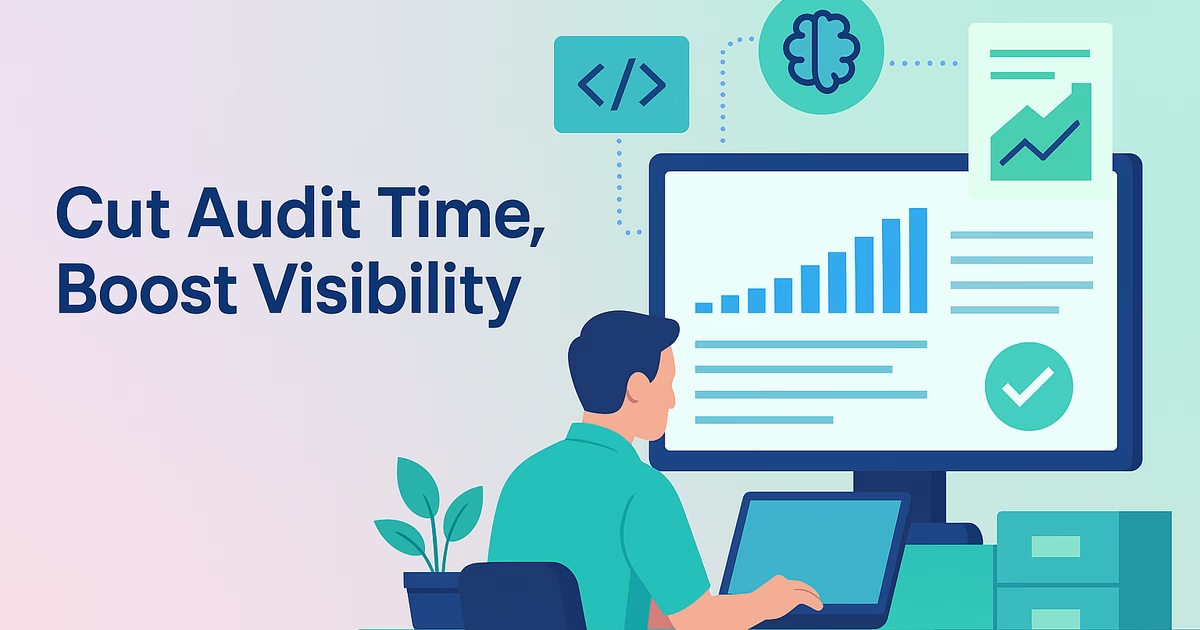
The minute a requisition hits your inbox, friction begins: spreadsheet trackers, endless email approvals, and siloed ERPs that leave you crossing your fingers that the three-way match works. Yet boards still expect airtight compliance and zero maverick spend. The good news? You can achieve both. Companies that automate GRC processes cut audit-prep time by 35% (Allgress, 2024), proving the payoff of governance automation is real. In this article, you’ll learn exactly how this automation removes manual choke points, which procurement risk control software features are essential, and a practical roadmap you can start tomorrow.
Why Manual Procurement Risk Controls Are Costly and Risky
Manual, people-dependent controls look inexpensive on paper but drain resources in practice. When every contract clause or supplier onboarding questionnaire lives in a different folder, teams waste hours reconciling data and chasing signatures. This late involvement leads to shadow purchasing; at best, audit trails are partial. Worse, CFOs lack critical spend visibility, making it impossible to forecast exposure or enforce service level agreements (SLAs). For CIOs, disconnected spreadsheets create data-integrity nightmares and cybersecurity gaps that no amount of patching can fix. These issues highlight the critical need for robust procurement risk controls GRC.
- Duplicate Effort: Re-keying data across ERP, contract repository, and risk platform kills productivity.
- Delayed Approvals: Email strings add days to cycle time, jeopardizing volume rebates.
- Partial Audit Trails: Evidence scattered across SharePoint and local drives invites non-conformances.
- Reactive Risk Management: Supplier issues surface after the fact, forcing expensive remediation.
How GRC Automation Transforms Procurement Risk Control
Governance automation flips the script by embedding procurement risk controls directly into the purchase-to-pay (P2P) cycle. For instance, automated supplier onboarding enforces background checks before a vendor code is even created. Service level agreement (SLA)-based workflows automatically trigger alerts when supplier performance dips below thresholds. Real-time dashboards give CFOs the spend visibility they need to forecast cash accurately, while integrated audit trails mean external auditors can self-serve evidence—no more time-consuming PDF hunts. This is a core benefit of GRC automating procurement risk controls in the supply chain.
Key Outcomes Leadership Cares About
- Faster Approvals: Auto-routing based on deal value cuts cycle time by up to 50%, freeing cash discounts.
- Reduced Compliance Cost: GRC automation can shrink operational compliance spend by 30% (CyberSierra, 2024).
- Risk Mitigation: Continuous monitoring flags OFAC-sanctioned suppliers before contracts are signed.
- Data Integrity: A single source of truth eliminates conflicting supplier master data in finance and procurement systems.
Where Automation Delivers the Biggest Punch
- Supplier Due Diligence: API-based screening automatically pulls ESG scores, financial health, and sanctions data, essential for effective procurement risk controls.
- Contract Governance: Clause libraries enforce standard Terms & Conditions (T&Cs); any deviations automatically trigger legal review.
- Three-Way Match Controls: Exception handling rules highlight price-quantity mismatches instantly, preventing leakage.
- Spend Analytics: AI models surface maverick spend patterns in real time, a key procurement risk control software feature.
The Strategic Automation Framework for Procurement GRC
A successful rollout is not a big-bang IT project; rather, it’s a phased program aligned to your organization’s risk appetite and resource bandwidth. Below is a five-step framework that senior leaders can champion when considering how to implement procurement risk controls automation.
- Define Risk Taxonomy
Establish a common language for risk control in procurement—supplier, contract, performance, ESG. Map each to regulatory requirements and internal policies.
- Prioritize Controls by Impact
Use a risk-heat map to rank controls that materially affect financial statements or compliance exposure. Start automation where ROI and risk reduction intersect.
- Select Fit-for-Purpose Technology
Evaluate solutions against a procurement-specific checklist (see comparison table). Consider APIs, rule engines, and AI for continuous monitoring.
- Hard-Wire Controls into Workflows
Embed checks into the intake-to-pay process—not as after-the-fact approvals. Configure SLA-based workflows and automated escalations.
- Measure, Learn, Scale
Track metrics such as approval cycle time, audit findings, and maverick spend reduction. Iterate configurations before expanding to new business units.
Watch Out
Integration is rarely a plug-and-play affair. Legacy ERPs often expose batch-only interfaces. Build a data-mapping layer early to avoid manual file swaps that recreate the very friction you’re eliminating.
Procurement Risk Control Software Features That Matter
C-suite sponsors want to see a direct line from feature to outcome. The table below distills must-have capabilities for GRC automating procurement risk controls in supply chain environments.
| Feature | Why It Matters | Outcome if Missing | Questions to Ask Vendors |
|---|---|---|---|
| API-First Architecture | Seamless data flow across ERP, SRM, and risk platforms | Manual imports re-emerge | “What pre-built connectors exist for SAP/Oracle?” |
| Rule-Based Approval Engine | Tailors workflows to spend limits, risk tiers | One-size approvals create bottlenecks | “Can business users edit rules without IT?” |
| Continuous Supplier Monitoring | Flags financial distress, sanctions, ESG breaches | Reactive risk management | “How often are data feeds refreshed?” |
| Audit Trail Automation | Time-stamped evidence for every decision | Painful audit cycles | “Can we export audit logs in standard formats?” |
| AI-Driven Spend Analytics | Detects maverick patterns and duplicate invoices | Hidden leakage persists | “What ML models underpin anomaly detection?” |
Note: Keep feature lists short and outcome-oriented for executive readability. Detailed RFP criteria belong in the procurement toolkit, not the board deck.
Proof of Value: Real-World Outcomes, ROI, and Benchmarks
Stakeholders need evidence beyond vendor slides. Integrated GRC tools deliver real-time risk reports, improving decision speed by 25% (StandardFusion, 2024). Coupled with the 35% audit-prep reduction noted earlier, automation pays back quickly through headcount redeployment and avoided penalties.
In one Fortune-500 manufacturing firm (internal data), automating supplier onboarding slashed average cycle time from 14 to 5 days, enabling early-payment discounts worth $2 million annually. Legal appreciates standardized clauses; finance enjoys cleaner accruals; procurement reclaims bandwidth for strategic sourcing. The intangible win: leadership now trusts the P2P data set, making spend forecasts board-ready.

5 Next Steps to Accelerate Procurement GRC Automation
You don’t need a blank-check project plan to make progress. Start small, show wins, and scale.
- Audit Current Controls
Inventory manual checkpoints, owners, and failure points. Identify duplicate or skipped steps. - Quantify Friction Costs
Calculate hours spent on approvals, audit evidence collection, and rework. Tied to the salary burden. - Create a Business-Case Lite
Use the research stats to model savings; 30% compliance cost reduction is a strong starting point. - Pilot a High-Risk Category
Choose IT or marketing spend where maverick activity is rampant. Measure cycle time and compliance adherence before and after. - Secure Executive Sponsorship
Present pilot results using language that the CFO and CIO value: risk reduction, cash optimization, system resilience.
FAQ: Procurement GRC Automation Clarified
Q: What are the most common procurement risks addressed by GRC automation?
A: Supplier solvency, sanctions violations, contract non-compliance, data privacy breaches, and maverick spend top the list. Automation embeds controls early to mitigate them.
Q: How do you automate risk controls in complex supply chains?
A: Start with a unified risk taxonomy, integrate supplier data feeds, and embed rule-based workflows that trigger escalations when thresholds breach.
Q: Which features are essential in procurement risk control software?
A: API-first design, configurable approval engines, continuous monitoring, automated audit trails, and AI-powered spend analytics.
Q: How does GRC automation improve spend visibility?
A: By consolidating transaction, contract, and risk data into one dashboard, leaders see committed spend, potential exposure, and compliance status in real time.
Q: What are the biggest challenges when implementing procurement GRC automation?
A: Data integration with legacy ERPs, change management among users, and aligning risk appetite with workflow strictness.
Q: Can GRC risk controls integrate with existing ERP/procurement tools?
A: Yes, provided the platform offers open APIs or certified connectors. Prioritize vendors with proven integrations to your ERP landscape.
Conclusion: From Friction to Foresight
Manual governance drains resources and keeps the C-suite in the dark. By embedding procurement risk controls GRC automation directly into the intake-to-pay workflow, teams turn compliance from a simple checkbox into a strategic lever. Procbay’s API-first, AI-driven platform has helped enterprises move from “spreadsheet wrangling” to real-time foresight, often within one quarter, while coexisting seamlessly with systems like SAP, Oracle, and Coupa.
Connect with our procurement experts to tailor an AI-governed sourcing strategy for your enterprise.
Contact Us