Summary:
Moving from static RFQs to dynamic reverse auctions requires calculated auction bidding strategy, more than just procurement software. When category managers launch an event without precise baseline pricing, optimal lotting, and strategic decrement rules, they risk supplier disengagement and the dangerous “winner’s curse.” This guide breaks down the actionable auction bidding tactics that enterprise procurement teams use to drive double-digit cost savings while preserving supplier viability and minimizing supply chain risk.
Auction Bidding Strategy: Engineering the Event for Maximum Cost Savings
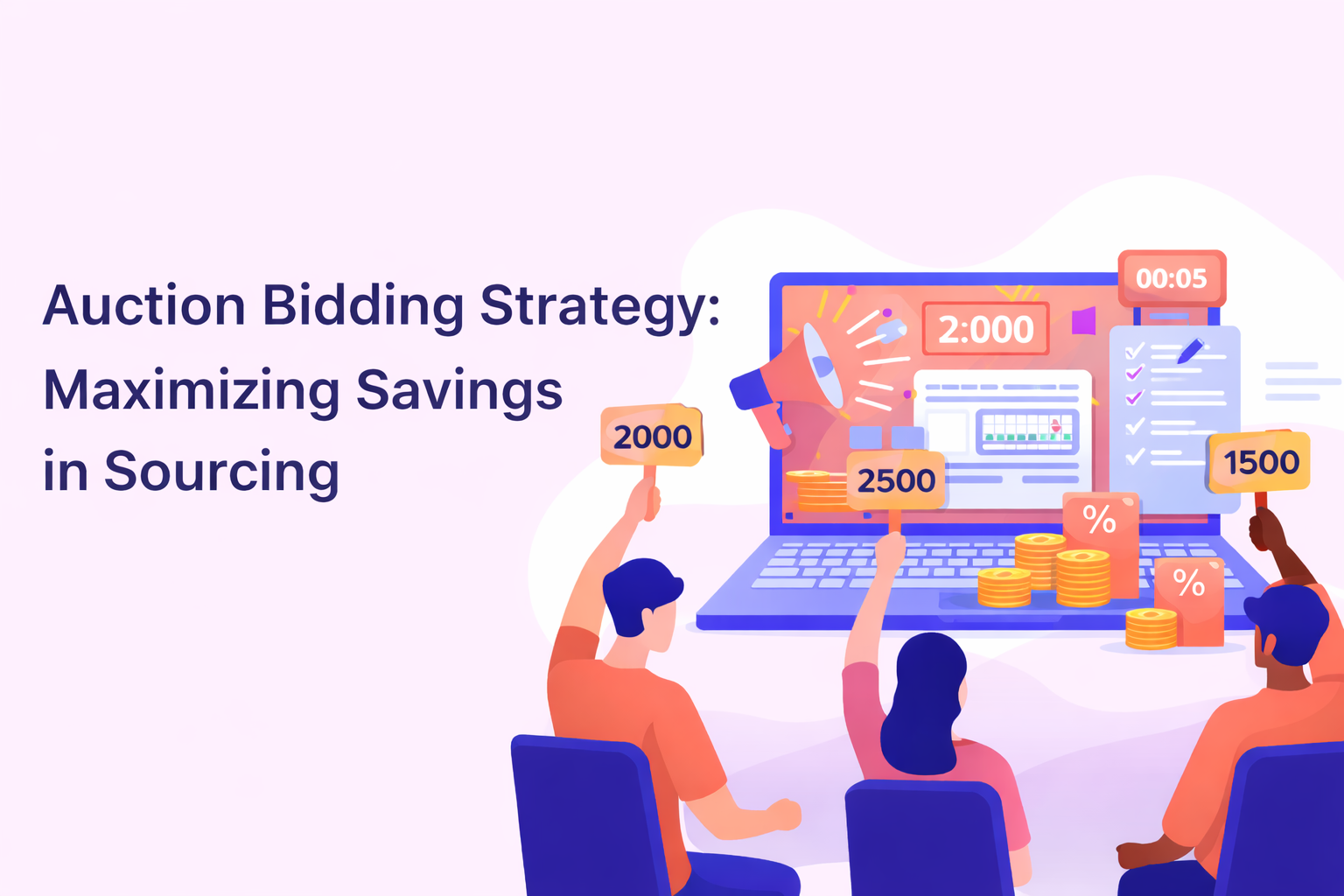
You are 15 minutes into a live reverse auction. Supplier A has stopped bidding. Supplier B just dropped their price by an aggressive 20% in a single step, well below your internal cost modeling. Instead of celebrating the projected savings, your stomach drops. You know that a bid that low likely means compromised quality, scope creep, or a supplier who will try to renegotiate the contract in six months.
Executing a successful sourcing event is not about squeezing suppliers until they break. It is about using competitive tension to find the true market price. Without a structured auction bidding strategy, eAuctions frequently devolve into a race to the bottom that ultimately damages your supply chain.
To turn an eAuction into a reliable engine for cost avoidance and cycle-time reduction, procurement teams must treat the event design with the same rigor as the contract execution.

The Pre-Event Baseline: Qualification Over Price
An auction is only as effective as the suppliers invited to participate. Throwing an open invitation to unvetted vendors destroys the integrity of the event. If incumbent, high-performing suppliers see that they are competing against unverified, low-cost entrants, they will either refuse to participate or bid defensively.
Before configuring the bidding parameters, ensure every participant has passed a strict Technical Evaluation and Supplier KYC process.
- 73% of procurement leaders cite supplier risk as a primary concern during competitive sourcing events. Commercial Implication: Pre-qualifying suppliers ensures that every bid submitted during the auction is from a viable, low-risk partner, making the final award decision purely commercial rather than defensive.
When you lock down the baseline quality, the live auction can focus entirely on the auction pricing strategy.
Architecting Auction Bidding Tactics
The rules you set govern the outcome you get. Procurement managers must carefully configure the mechanics of the event to keep suppliers engaged without exhausting them.
-
Starting Prices and Reserve Setting
Never start an auction without a ceiling. The starting price should ideally be based on the historical baseline or the lowest valid bid from a preliminary RFI. Setting a firm reserve price, the maximum price you are willing to accept signals to the market that you have done your homework.
-
Strategic Decrement Rules
A core component of bidding techniques at auction is the decrement rule. If the minimum bid decrement is too small, the auction drags on indefinitely, frustrating participants. If it is too large, suppliers may hit their floor too quickly and drop out. Scale decrements relative to the total lot value.
Did You Know?While historically reserved for indirect commodities, over 40% of high-performing procurement organizations now successfully use reverse auctions for complex, multi-variable services like logistics and IT consulting by heavily utilizing weighted bidding models. |
| (Source: Gartner — Strategic Sourcing and eAuction Trends — 2023) |
-
Lotting Strategies
Consolidating items into logical lots prevents cherry-picking. If you allow suppliers to bid aggressively on high-margin items while ignoring complex deliverables, your total cost of ownership (TCO) will spike. Grouping items ensures that suppliers must compete for the entire commercial package.
Commercial Impact
Transitioning from manual spreadsheets to automated, governed auction environments drastically alters the commercial math for category managers.
- Organizations leveraging automated sourcing workflows and spend analysis, report an average cycle time reduction of 30% -50% in transactional sourcing. Commercial Implication: Shrinking the sourcing cycle means enterprise procurement teams can execute more events per quarter, driving higher overall spend under management.
Navigating the “Winner’s Curse”
The most dangerous outcome of a reverse auction is the “winner’s curse”, when a supplier bids so aggressively to win the business that they cannot profitably deliver the goods or services.
To prevent this, sophisticated procurement teams use multi-parameter bidding. Instead of awarding solely on the lowest unit price, the system automatically weighs the bid against lead times, payment terms, and historical supplier performance metrics.
Understanding the benefits of e-procurement auctions requires looking past the immediate price drop and evaluating the total contracted value.
Traditional Sourcing vs. Engineered eAuctions
| Sourcing Element | Static RFx Process | AI-Governed eAuction |
| Price Discovery | Blind, single-round negotiation | Real-time, market-driven compression |
| Cycle Time | 4–6 weeks of email back-and-forth | 1–2 hours for the live competitive event |
| Supplier Feedback | Delayed, manual status updates | Instant rank or lead-price visibility |
| Award Basis | Often instinct-driven or spreadsheet-heavy | Fact-based, weighted TCO analysis |
Conclusion
An effective auction bidding strategy shifts procurement from a passive administrative function into an active commercial driver. By meticulously controlling the pre-event qualification, configuring smart decrement rules, and focusing on total cost of ownership rather than just the lowest initial price, category managers can run events that deliver sustainable savings. The goal is not just to compress the price today, but to lock in a commercially viable, high-performing supplier for the life of the contract. Engineering the event upfront is the only way to protect the supply chain while capturing true market value.
Transforming your competitive bidding process requires more than basic software; it requires an intelligent execution engine. Stop relying on fragmented spreadsheets, disconnected emails, and gut-instinct negotiations. If your team is ready to drive governed, high-yield sourcing events that protect supplier relationships while capturing true market value, it’s time to upgrade your procurement infrastructure.
Frequently Asked Questions
Q: What is the “winner’s curse” in a procurement auction?
A: The winner’s curse occurs when a supplier wins an auction by bidding below their actual cost of delivery. This often leads to contract renegotiations, poor quality, or supply chain disruptions down the line.
Q: How do you determine the starting price for an eAuction?
A: Starting prices should be informed by the historical price paid, current market indices, or the lowest viable bid received during a preliminary RFI phase. This anchors the auction in reality.
Q: What is a bid decrement and why does it matter?
A: A bid decrement is the minimum amount a supplier must lower their price to submit a valid new bid. Setting it correctly ensures the auction moves at a brisk pace without forcing suppliers to drop past their absolute floor prematurely.
Q: Can you use reverse auctions for services instead of just goods?
A: Yes. While goods are simpler to commoditize, enterprise services can be auctioned effectively if the scope of work is rigidly defined and the bidding parameters include weighted factors like service level agreements (SLAs) and deployment timelines.
Connect with our procurement experts to tailor an AI-governed sourcing strategy for your enterprise.
Contact Us