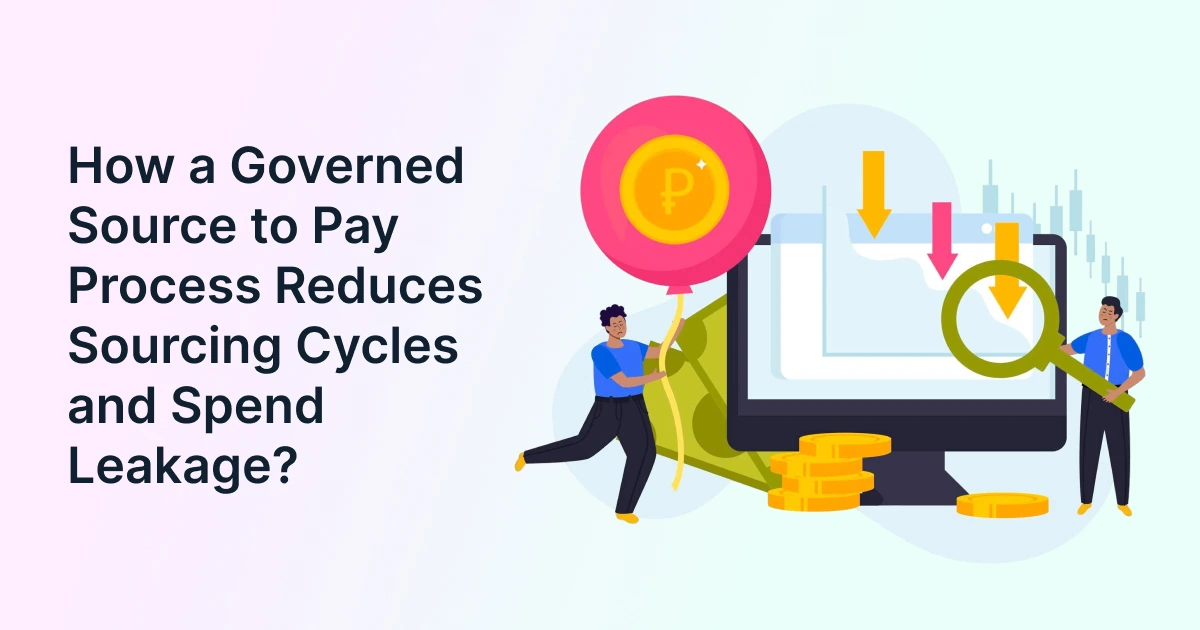
Summary: Disconnected sourcing events and downstream purchasing tools create structural handoff friction, causing negotiated savings to disappear before an invoice is ever generated. Modernizing your source-to-pay operations requires linking front-end intake directly to contract execution and payment validation. By connecting these workflows through integrated strategic sourcing and P2P orchestration, enterprise procurement teams eliminate spend leakage and accelerate event cycle times.
In short: A unified source-to-pay process can help reduce sourcing cycle times by connecting intake, sourcing, contracting, purchasing, and payment workflows.
When strategic sourcing teams hand off negotiated contracts to operational purchasing, savings routinely evaporate through disconnected tools and unmonitored buying channels. Sourcing managers spend weeks running competitive RFx events, only for business units to buy off-contract because the ERP lacks visibility into active pricing agreements.
This structural break between sourcing strategy and transaction execution represents the costliest inefficiency in modern supply management. Bridging this gap requires an end-to-end framework that governs intake, automates sourcing, enforces contract compliance, and validates supplier payments under a single operational architecture.

What Is the Source to Pay Process and Why Do Siloed Workflows Fail?
To optimize operational throughput, you need an integrated source to pay framework that unifies upstream strategy with downstream execution. The source to pay (S2P) process connects activities across supplier discovery, strategic sourcing, contracting, purchasing, and payment. While traditional organizations split this domain into strategic sourcing (Source-to-Contract) and operational buying (Procure-to-Pay), operating them as isolated processes can create significant handoff friction.
When upstream teams store rate cards in static PDFs while downstream buyers submit requisitions via disparate ERP forms, compliance falls apart. A buyer in a regional office selects a convenient supplier rather than the strategic partner negotiated by the category team. The result is administrative rework, delayed approvals, and rampant tail spend.
The Point-Solution Trap: High Tech Spend, Low Efficiency
Many procurement organizations attempt to fix operational drag by layering point-solution procurement tech stacks over legacy infrastructure. They deploy dedicated e-sourcing tools, separate contract lifecycle management systems, and standalone AP automation tools.
While individual tools optimize local tasks, they fragment data across the enterprise. Category managers waste hours manually re-keying supplier details from RFx platforms into contract repositories, while finance teams manually reconcile purchase orders against disconnected contract terms.
True operational efficiency does not necessarily require replacing every point solution. It requires an integrated architecture in which procurement data and workflows can move reliably from intake through settlement.
Distinction between S2C, P2P, and S2P
| Process | Focus |
| Source-to-Contract (S2C) | Spend analysis, supplier discovery, RFx, negotiation, award and contracting |
| Procure-to-Pay (P2P) | Requisitioning, purchasing, receiving, invoice processing and payment |
| Source-to-Pay (S2P) | Connects S2C and P2P into an end-to-end procurement process |
How Does Source-to-Pay Integration Eliminate Spend Leakage?
To prevent spend leakage, you must enforce contractual compliance at the exact point where a purchasing requisition originates. Spend leakage occurs when non-compliant buying, unauthorized price variance, or unbilled discount terms erode negotiated cost reductions. Integrating downstream execution with upstream contracts ensures that every purchase order automatically inherits negotiated pricing, terms, and supplier preferences.
When an enterprise lacks automated guardrails between contract finalization and PO creation, maverick spend flourishes. Business units bypass preferred suppliers because finding compliant catalogs requires navigating complex legacy portals.
The cost of this disconnect extends beyond missed savings. Operating without unified visibility exposes organizations to severe regulatory and financial risks:
- Margin Erosion: Contracted volume discounts expire unused because purchases are fragmented across non-preferred vendors.
- Audit and Compliance Risk: Inconsistent onboarding and missing KYC documentation during hasty purchases lead to severe compliance audit findings.
- Supplier Risk Escalation: Downstream buyers place orders with suppliers whose TPRM compliance certificates or insurance coverage have lapsed.
Connecting intake requests to active contract intelligence eliminates these risks. By deploying an intake workflow agent, incoming business requests are automatically checked against existing agreement terms before an expensive new sourcing event is even initiated.
“Procurement is at the forefront of managing increasing supply market complexity, and successful CPOs know that harnessing the power of digital and AI is helping drive resilience, efficiency, and growth. Organizations that prioritize both tech modernization and talent investment are better able to not only survive but thrive amid market fluctuations.”
3 Capabilities That Improve Source to Pay Efficiency
- Guided Intake & Demand Management: Instead of forcing stakeholders to navigate complex ERP coding, guided intake portals capture requirement details upfront. Requestors answer simple contextual questions, allowing the platform to route the demand correctly, whether that means drawing from a pre-negotiated catalogue, triggering a competitive eAuction, or directing the request to legal counsel.
- Automated Bid Analysis: Manual spreadsheet comparison of multi-attribute vendor bids can consume significant category management time. Leveraging a dedicated bid analysis agent allows procurement teams to evaluate complex pricing matrices, total cost of ownership (TCO) variables, and capacity constraints in seconds, accelerating decision-making without sacrificing analytical depth.
- Contract Intelligence & Obligation Tracking: Contracts must function as dynamic control mechanisms rather than dormant PDF files. Modern S2P platforms extract key clauses, penalty structures, and price tiers, linking them directly to invoice validation workflows in real time.

Business Case Autopsy: How a Global Manufacturer Unlocked S2P Throughput
A mid-tier industrial equipment manufacturer operating six regional plants struggled with a 52-day average sourcing cycle and a 24% maverick spend rate. Their category teams conducted rigorous competitive bidding in standalone software, but plant-level buyers frequently placed urgent purchase orders via direct email to legacy suppliers using outdated price sheets.
To resolve this operational drag, the organization overhauled its S2P architecture. They replaced paper-based requisitions with guided intake channels and connected their RFx engine directly to contract creation and purchasing workflows.
By unifying these operations through Procbay, the manufacturer achieved immediate operational gains:
- Cycle Time Reduction: Sourcing cycle times plummeted from 52 days to 14 days by automating vendor evaluation and contract drafting.
- Leakage Elimination: Maverick spend dropped from 24% to under 2% within six months as purchase orders were locked to pre-approved catalogue terms.
- Audit Accuracy: Downstream invoice mismatches were reduced by 91%, eliminating manual accounts payable holdbacks.
Manual S2C/P2P vs. Unified Source to Pay Platform Operations
| Operational Metric | Legacy Disconnected Operations | Unified Source to Pay Platform |
| Sourcing Cycle | Manual coordination and multiple handoffs | Automated workflows and centralized evaluation |
| Maverick Spend | Greater risk of off-contract purchasing | Guided buying and contract enforcement |
| Contract Compliance | Low; terms buried in static PDF repositories | High; dynamic clause extraction tied to PO rules |
| Supplier Onboarding | Manual document collection and validation | Automated |
| Spend Visibility | Delayed, fragmented | Centralized, near-real-time visibility |
Conclusion
Modernizing the source-to-pay process is a structural realignment of how an enterprise manages its third-party costs. By removing the friction between strategic sourcing decisions and daily purchasing actions, organizations eliminate spend leakage, lower compliance risks, and improve throughput.
Procurement leaders who unify these functions replace reactive administration with governed, predictable execution.
If your team is evaluating how to eliminate spend leakage and accelerate sourcing cycle times with a governed architecture, a brief walkthrough can clarify what that looks like in practice. Connect with us for a live platform demo today.
Frequently Asked Questions
Q: What is the source to pay process in procurement?
A: The source-to-pay (S2P) process is an end-to-end procurement framework that covers every activity from initial spend intake and strategic sourcing to contract execution, purchasing, and invoice payment. By linking upstream sourcing strategy directly with downstream payment validation, an integrated S2P process eliminates spend leakage, enforces contract compliance, and ensures negotiated savings directly impact the financial bottom line.
Q: What is the difference between source to pay (S2P) and procure to pay (P2P)?
A: Procure to pay (P2P) is a transactional subset focused strictly on downstream operations: requisitioning, purchase order creation, goods receipt, and invoice processing. Source to pay (S2P) is a broader framework that encompasses P2P while integrating upstream strategic sourcing activities, such as spend analysis, supplier discovery, eAuctions, and contract lifecycle management, into a single governed workflow.
Q: How does an S2P process reduce maverick spend?
A: An integrated S2P process reduces maverick spend by automatically enforcing negotiated contract terms at the point of requisition. When business units submit buying requests, guided intake tools direct users toward preferred suppliers and pre-approved catalogues, preventing employees from buying off-contract or selecting unvetted vendors.
Q: What are the key stages of a modern source to pay framework?
A: A modern S2P framework consists of six core stages: structured intake and demand management, strategic sourcing (RFx/eAuctions), supplier lifecycle management, contract intelligence execution, procure-to-pay transactional purchasing, and automated spend analytics paired with budget controls.
Q: Why do traditional S2P platform implementations stall?
A: Traditional implementations fail when platforms force rigid, complex workflows onto casual end-users or rely on fragmented point solutions that require heavy manual data entry. Successful S2P adoption requires intuitive intake orchestration that simplifies requisitioning while automating backend risk, contract, and compliance checks behind the scenes.
Q: How does AI improve source to pay process efficiency?
A: Artificial intelligence speeds up the S2P process by automating labor-intensive manual tasks. AI agents automatically analyze complex supplier bids, draft contracts from standard clause libraries, score vendor compliance risks, and categorize spend data in real time, reducing cycle times significantly.
Q: How do you measure ROI on a source to pay platform?
A: ROI on an S2P platform is measured through four core financial indicators: realized savings capture (eliminating contract leakage), reduction in sourcing cycle times, percentage reduction in maverick spend, and operational productivity gains achieved by automating manual RFx analysis and invoice matching workflows.
Q: What role does supplier lifecycle management play within S2P?
A: Supplier lifecycle management (SLM) provides the foundational trust layer across the entire S2P journey. It ensures that vendor qualification, performance monitoring, regulatory compliance, and risk scoring are continuously updated and embedded into sourcing awards and transactional purchasing decisions.
Connect with our procurement experts to tailor an AI-governed sourcing strategy for your enterprise.
Contact Us