Summary:
As procurement operations expand, the number of approval layers, supplier checks, and compliance requirements also increases. What was once manageable slowly becomes a burden. Workflow agents improve business efficiency by bringing organization to procurement processes. A Primary workflow agent directs requests from intake to order completion. Meanwhile, secondary workflow agents automate tasks like validation, compliance, and routing under a centralized Workflow Agent Manager. This setup creates quicker, clearer, and more scalable procurement operations.
Why Procurement Efficiency Slows Down Over Time
Procurement teams rarely have issues due to a lack of expertise. Instead, inefficiencies often arise as organizations grow and processes become more complex.
A purchase request may require approval from the department, validation from finance, verification of the vendor, review of the contract, and confirmation of compliance. Each step adds control but also causes delay. When these steps are handled manually through emails, spreadsheets, or disconnected tools, coordination becomes a major obstacle.
As transaction volumes rise, teams spend more time tracking approvals and fixing documentation gaps than on strategic sourcing or working with suppliers. Visibility into the status of requests becomes scattered. Escalations occur reactively rather than proactively.
This gradual buildup of friction makes workflow agents essential for business efficiency, serving not just as a convenience but as necessary infrastructure.

What Are Workflow Agents in Procurement?
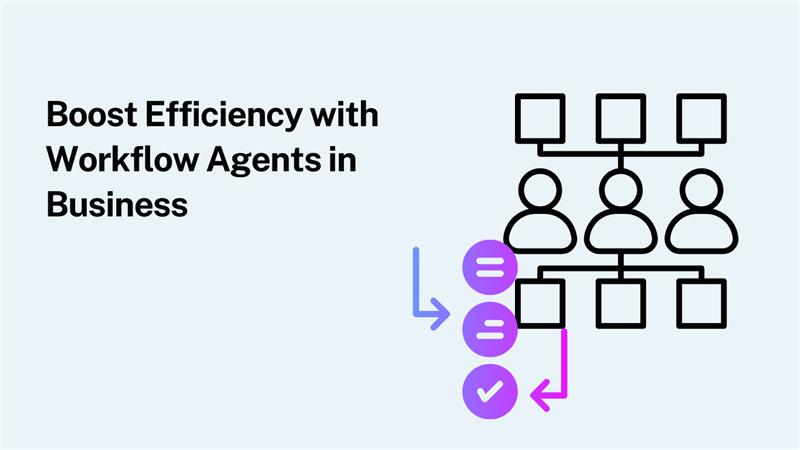
Workflow agents are automation components that manage and execute business processes. Unlike separate automation tools, they coordinate entire lifecycles.
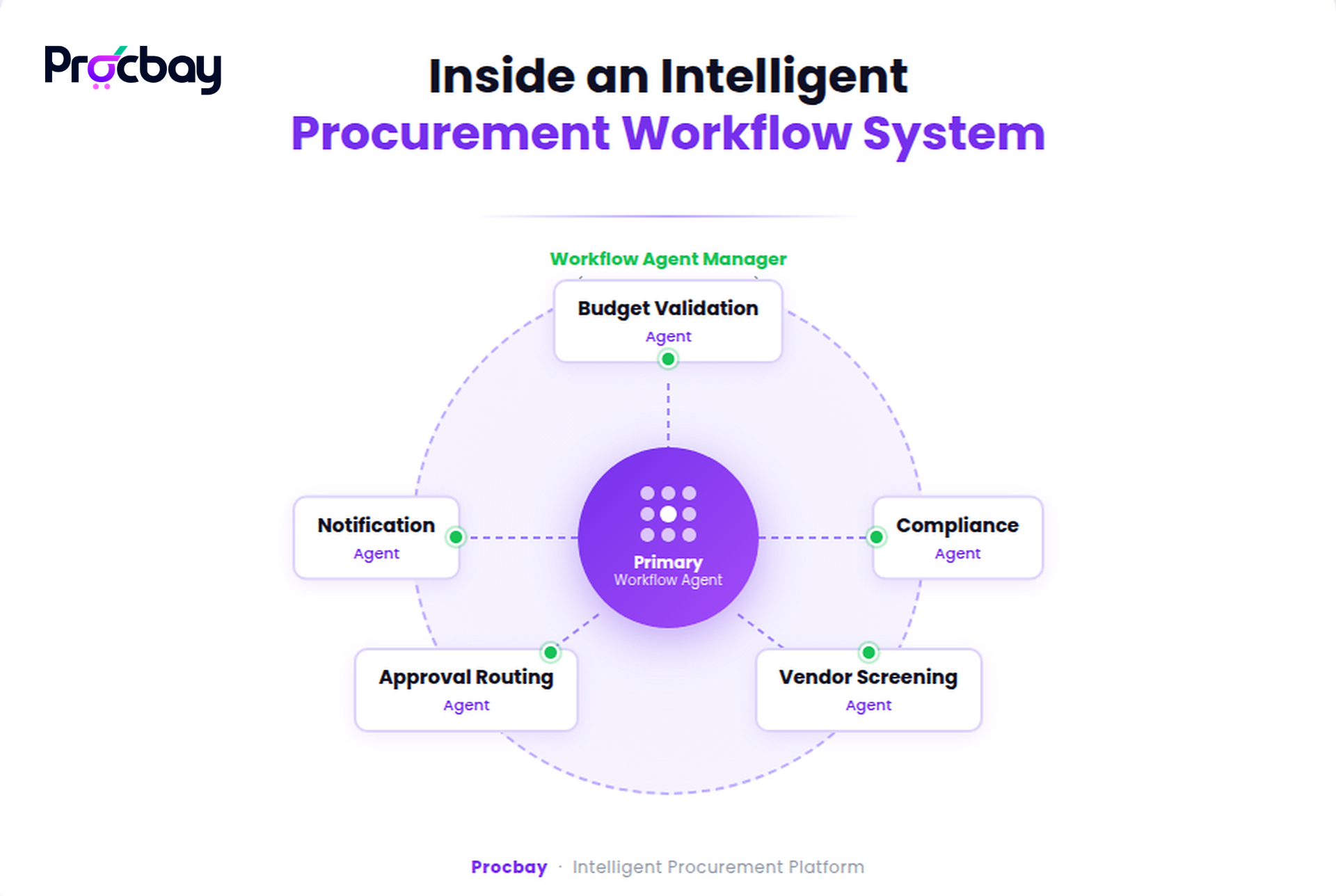
In a procurement setting, an effective agent workflow includes three main elements:
Primary Workflow Agent
The primary workflow agent serves as the central organizer. It controls the entire lifecycle of a procurement request, from structured intake submission to approval routing and purchase order creation. It ensures each stage follows the set business rules.
Secondary Workflow Agents
Secondary workflow agents take care of specific tasks within the larger process. These may include:
- Budget availability checks
- Preferred vendor validation
- Contract compliance verification
- Risk screening
- Escalation triggers
- Notification routing
Because these validations can run simultaneously when policy allows, processing times are significantly reduced.
Workflow Agent Manager
The Workflow Agent Manager provides centralized oversight. It enables procurement leaders to monitor SLA adherence, approval timelines, bottlenecks, and performance metrics in real time.
Together, this structured orchestration enables measurable workflow agents business efficiency across sourcing and supplier operations.
The Hidden Cost of Sequential Approvals
Traditional procurement workflows usually have a strict step-by-step structure. A request stays in one inbox before moving to the next. If documentation is incomplete, the process starts over. If an approver is unavailable, delays add up.
This model creates:
- Longer cycle times
- Increased administrative follow-ups
- Compliance inconsistencies
- Reduced spend visibility
- Limited scalability
Many organizations already invest in digital procurement systems to improve spend transparency. For example, businesses using structured catalog systems often see better purchasing consistency and policy match. However, as noted in Automated Catalog Management: Key Benefits for Enterprises, just digitizing catalogs does not remove approval friction unless workflow management supports it in the background. Automation needs to go beyond data visibility to include process intelligence.
Intelligent Intake and Categorization
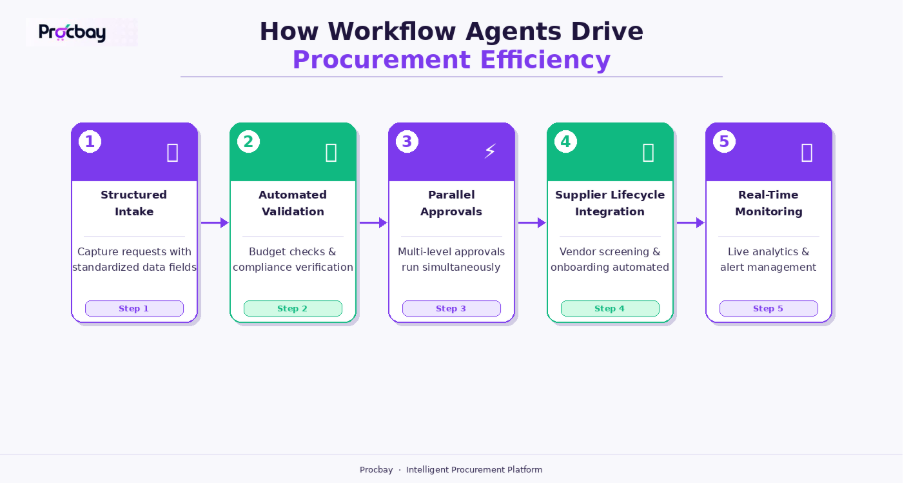
A primary workflow agent ensures that every request enters the system through structured intake channels rather than informal submissions. Requests are automatically categorized based on department, spend threshold, urgency, and vendor type.
This structured intake supports broader sourcing strategies. Organizations refining their effective sourcing strategy often discover that intelligent routing ensures sourcing policies are consistently applied across all requests.
Automated Policy Enforcement and Budget Validation
Secondary workflow agents check budget limits, ensure preferred vendor compliance, and confirm contract alignment instantly. Instead of finding policy violations later, the system flags discrepancies during validation. For organizations using competitive bidding models, especially those that use a reverse auction strategy, smart validation makes sure that award decisions get approved quickly while still keeping governance control in place.
Parallel Approval Routing
One of the strongest drivers of workflow agents business efficiency is the shift from sequential to parallel approvals. When business rules permit, finance, compliance, and department approvals can proceed simultaneously.
This significantly reduces cycle time without compromising oversight.
Supplier Lifecycle Integration
Procurement does not stop with purchase approvals. Supplier onboarding, managing documents, tracking performance, and handling renewals all require organized coordination.
Organizations that establish their supplier lifecycle management framework often discover that using workflow automation helps keep vendor documents up to date and allows compliance reviews to happen regularly instead of only when issues arise.
Real-Time Monitoring and Escalation
Efficiency in procurement is not only about moving requests faster, it is also about maintaining visibility throughout the process. A centralized Workflow Agent Manager enables real-time tracking of approval status, SLA adherence, and escalation triggers.
Instead of waiting for stakeholders to report delays, the system proactively flags bottlenecks and notifies relevant teams. This ensures that governance remains strong even as cycle times improve.
Measurable Impact on Procurement Operations
Organizations that implement structured workflow automation typically report:
- 50–70% reduction in approval turnaround time
- Fewer manual follow-ups
- Improved audit readiness
- Reduced maverick spending
- Greater cross-department transparency
When workflow logic is embedded directly into the procurement lifecycle, operational consistency improves naturally.
Traditional Procurement vs Agent Workflow Model
| Metric | Traditional Model | Agent Workflow Model |
| Approval Cycle | Sequential & Delayed | Parallel & Accelerated |
| Error Rate | Higher | Significantly Reduced |
| Visibility | Limited | Real-Time |
| Escalations | Manual | Automated |
| Scalability | Headcount Dependent | Process-Driven |
This structural shift is what defines sustainable workflow agents business efficiency.
Implementing Workflow Agents in Procurement
Adopting workflow agents does not require replacing existing systems overnight. Instead, it begins with identifying where orchestration gaps exist.
Start by reviewing your current workflow infrastructure to determine whether approval thresholds, escalation logic, and validation rules are clearly defined and system-driven rather than manually enforced.
From there:
- Map your existing procurement lifecycle.
- Define approval and compliance logic clearly.
- Deploy a primary workflow agent to orchestrate lifecycle stages.
- Configure secondary workflow agents for validation and monitoring.
- Monitor performance through a Workflow Agent Manager dashboard.
The goal is not simply automation — it is structured coordination.
The Future of Procurement Is Intelligent Orchestration
Procurement is changing into a strategic function that focuses on spending better, managing risks, and working closely with suppliers. As regulations grow stricter and supply chains link more closely, manual coordination methods are no longer effective. Workflow agents will keep developing with features like predictive routing, AI-driven compliance checks, and flexible approval processes. However, the main advantage stays the same: smart orchestration decreases friction while keeping control.
Workflow agents improve business efficiency by shifting from task automation to smarter processes.
Why Procbay Enables Structured Workflow Efficiency
Procbay’s procurement platform integrates intake management, sourcing tools, supplier lifecycle governance, and automation frameworks into a unified system.
By combining:
- A primary workflow agent for lifecycle orchestration
- Secondary workflow agents for validation and compliance
- A centralized Workflow Agent Manager for oversight
Procbay enables organizations to accelerate approvals, enhance compliance enforcement, improve supplier governance, and scale procurement operations without increasing administrative burden.
Transform Procurement Through Intelligent Workflow Automation
Efficiency in procurement no longer comes from adding more review layers or seeking approvals more aggressively. Instead, it comes from creating workflows that operate intelligently, enforce rules automatically, and give real-time visibility to stakeholders.
Workflow agents business efficiency makes this possible.
If you’re looking to modernize procurement operations, consider how Procbay’s intelligent workflow solutions can simplify intake, sourcing, and supplier management while ensuring full compliance control.
FAQs
Q: How do workflow agents improve procurement efficiency?
A: Workflow agents automate intake routing, budget validation, approval management, and compliance checks. This greatly lowers the need for manual coordination and speeds up procurement cycles.
Q: What is the role of a primary workflow agent?
A: The primary workflow agent manages the entire procurement lifecycle. It makes sure requests flow smoothly from submission to approval and then to purchase order creation.
Q: How do secondary workflow agents support supplier management?
A: Secondary workflow agents automate vendor screening, validate documentation, enforce policies, and handle notification processes during the procurement lifecycle.
Q: What does a Workflow Agent Manager provide?
A: It offers centralized dashboards for monitoring approvals, tracking SLAs, managing escalations, and analyzing workflow performance.
Q: Can workflow agents scale with enterprise procurement needs?
A: Yes. Agent workflow systems are designed to handle increasing request volumes while maintaining governance, transparency, and operational control.
Connect with our procurement experts to tailor an AI-governed sourcing strategy for your enterprise.
Contact Us