
Summary
A properly organized strategic procurement process integrates procurement with business objectives, cuts costs, and builds better supplier relationships. By systematically working on goals, spend analysis, implementing effective procurement strategies, supplier management, and technology adoption, businesses can ensure efficiency, compliance, and sustainable growth. Adding technology and indirect procurement strategies to the mix also helps ensure that spending on all categories is optimized. By adopting the right processes and using tools such as Procbay, procurement can become a force for creating business value.
Introduction:
Unstructured procurement can result in lost savings, poor supplier performance, and unforeseen risks that can cost organizations millions of dollars every year.
Organizations lacking a strategic procurement framework struggle to optimize spend, manage suppliers, and maintain compliance. Inefficient processes, fragmented supplier bases, and a lack of visibility into indirect spend can drive costs, slow operations, and limit innovation. The need to transform procurement into a strategic discipline is no longer a choice; it’s a necessity for achieving efficiency, cost savings, and sustainable growth.
In this blog, we will discuss a full strategic procurement process, including step-by-step information, effective procurement strategies, IT and indirect procurement knowledge, and measurement best practices to help businesses optimize spend, improve supplier performance, and fuel sustainable growth.
Step-by-Step: Strategic Procurement Process
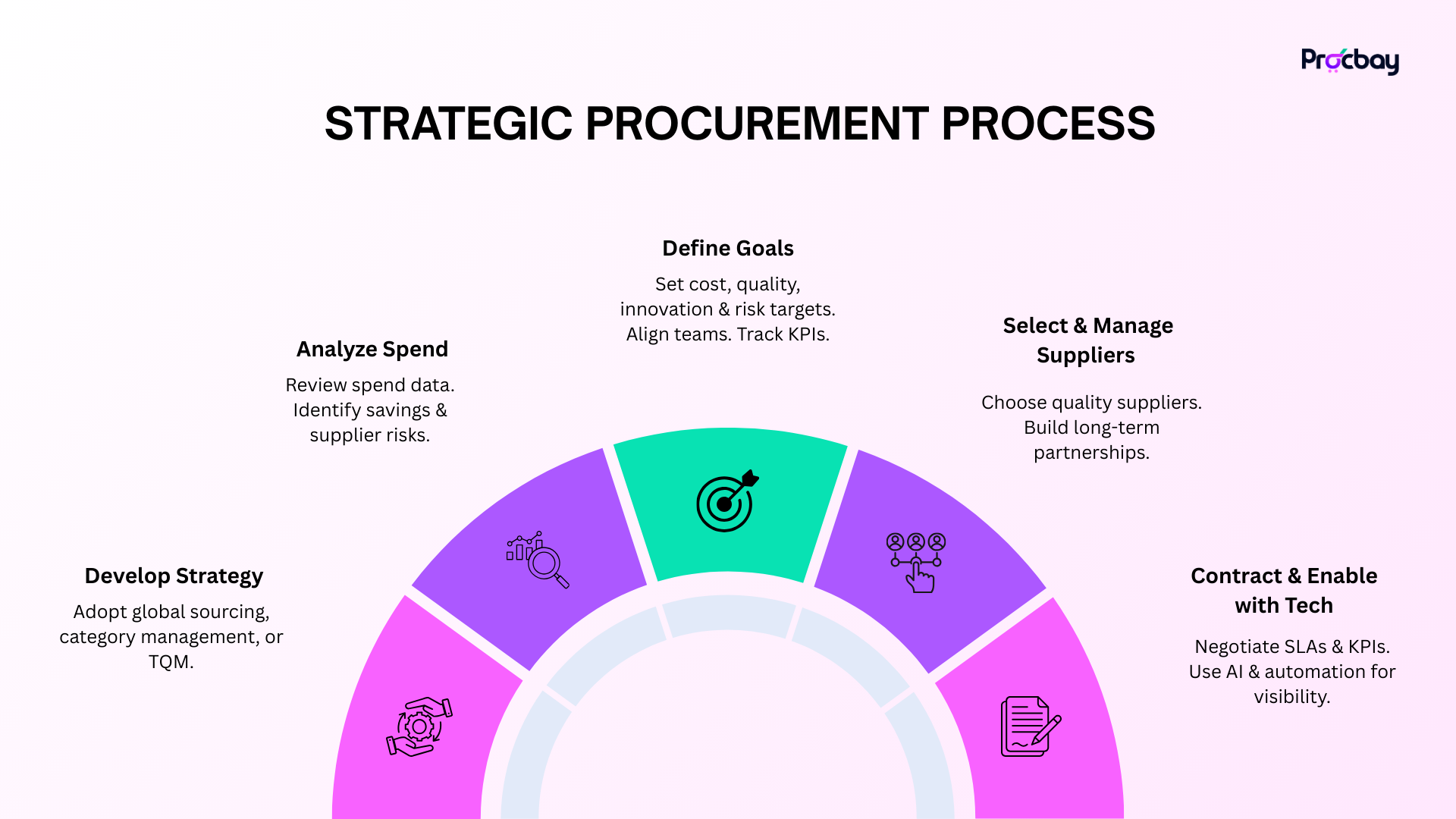
A properly conducted strategic procurement process will ensure cost efficiency, risk mitigation, and supplier performance. Follow these five detailed steps:
Step 1: Define Goals
Establish goals such as cost savings, quality, innovation, and risk mitigation. Align with finance, operations, and IT, and monitor KPIs.
Step 2: Analyze Spend
Assess spend behavior and supplier criticality. Uncover opportunities for savings, consolidation, and strategy refinement.
Step 3: Develop Strategy
Apply effective procurement strategies like global sourcing, category management, or TQM.
Step 4: Select & Manage Suppliers
Select suppliers on quality and capacity. Develop strong partnerships for collaboration, innovation, and continuous improvement.
Step 5: Contract & Enable with Technology
Negotiate terms beyond price, including service levels and KPIs. Leverage analytics, AI software, and automation for compliance, visibility, and informed decision-making.
These steps provide a structured approach that increases efficiency, lowers costs, and maximizes value.
Spend Smarter. Grow Faster.
Gain control of expenses and boost efficiency with Procbay.
Why a Strategic Procurement Process Matters
A strategic procurement process is essential for taking the procurement function forward from transactional work. It helps ensure that procurement activities are aligned with objectives such as cost savings, risk protection, innovation from suppliers, and compliance.
The implementation of the best procurement strategies enables organizations to maximize direct and indirect spend. Organizations that implement these strategies have reported an average annual cost savings of 15-20% and a 25-30% reduction in supplier risk. Strategic procurement also enables improved collaboration between different functions in the business, making procurement a major driver of business performance.
The integration of analytics, governance, and planning across the procurement process enables organizations to focus on suppliers, assess risks, and develop a long-term sourcing approach that maximizes value and efficiency.
Did you know?Organizations that implement strategic sourcing initiatives can achieve cost reductions of 8–12% annually. |
Special Focus: IT & Indirect Procurement Strategy
Many organizations overlook IT procurement strategy and indirect procurement, even though indirect spend, such as IT services, professional services, and office supplies, accounts for 20-30% of total procurement.
The IT procurement strategy is essential to ensure that technology procurement is aligned with enterprise architecture, security, and lifecycle strategies. Procurement strategy enables approval process simplification, vendor management, and cost savings through spend analytics.
IT and effective procurement strategies can be combined with procurement strategies to optimize processes, manage risk, and unlock additional value in all areas of spend.
Common Pitfalls in Procurement & How to Avoid Them
Even with a strategy, procurement can still experience problems that can drive costs or lower efficiency.
- Focusing only on price: Risks of quality and innovation.
Solution: Think about performance and capacity.
- Overlooking indirect spend: Hides costs.
Solution: Monitor and record all spending.
- Poor contract management: Lowers ROI.
Solution: Apply simple terms, KPIs, and check-ins.
- Poor supplier relationships: Prevents collaboration.
Solution: Interact and monitor performance.
- Manual processes: Causes delays and inaccuracies.
Solution: Apply technology and reduce manual touchpoints with automation.
By mitigating these pitfalls, it can be ensured that effective procurement strategies are achieved.
Did you know?Lack of standardization across procurement processes can lead to as much as 30% higher operating costs than industry leaders. |
Key Procurement Strategies and Their Benefits
To select the appropriate method, organizations can choose from the following procurement strategies. The strategies have a particular use and provide tangible benefits to businesses to optimize their spend and suppliers. The following table provides a list of the most effective strategies:
| Procurement Strategy | Purpose | Key Benefits |
| Global Sourcing | Source internationally for cost efficiency | Lower costs, competitive pricing, access to global suppliers |
| Category Management | Focus on high-spend categories | Deeper market insight, optimized supplier selection |
| Total Quality Management (TQM) | Long-term quality focus | Improved supplier performance, consistent quality, innovation |
| IT Procurement Strategy | Align technology purchases with business needs | Security compliance, lifecycle management, cost control |
| Indirect Procurement Strategy | Centralize non-core spend | Visibility, cost savings, reduced rogue spend |
By understanding the use and benefits of each strategy, procurement teams can identify the most effective strategy for their organization. By using these strategies in a strategic procurement process and effective procurement strategies, organizations can ensure cost savings and better supplier relationships for direct and indirect spend.
Procurement KPIs to Track
The measurement of procurement performance is essential for improvement. The most important KPIs are as follows:
- Cost Savings: Year-over-year savings against baseline spend
- Supplier Performance: On-time delivery, quality, and innovation contribution
- Compliance Rate: Contract compliance and regulatory requirements
- Procurement Cycle Time: Efficiency from requisition to purchase order
- Indirect Spend Coverage: Visibility and control of non-core spend
By monitoring these KPIs, procurement teams can analyze areas of inefficiency, improve supplier relationships, and make strategic procurement process improvements. These KPIs help to measure best procurement strategies and IT procurement initiatives.
Quick Checklist: Strategic Procurement Essentials
To make sure that your procurement organization is on the right track and is producing tangible outcomes, here is the critical checklist that you need to follow:
- Align your procurement strategy with business goals
- Perform comprehensive spend and market analysis
- Create effective procurement strategies for each category of spend
- Identify trustworthy suppliers and enable supplier relationship management.
- Use technology to enhance compliance, visibility, and decision-making
By following these steps, organizations can optimize their procurement processes and build strong relationships with their suppliers.
Simplify Procurement. Accelerate Growth.
Procbay’s AI streamlines requests, approvals, and vendors, so you save time and scale faster.
Measuring Success & Continuous Improvement
The critical metrics for an effective strategic procurement process are:
- Cost Savings: Year-over-year savings compared to the baseline cost
- Supplier Performance: Timely delivery, quality, and innovation input
- Process Efficiency: Cycle time and approval bottlenecks
- Compliance: Contract usage and policy compliance
Constant analysis and feedback help in pinpointing inefficiencies and optimizing supplier engagement. Strategic measurement can speed up the sourcing process by as much as 30% and boost ROI.
Procbay: Driving Procurement Transformation
At Procbay, we assist companies in adopting a strategic procurement process that yields tangible outcomes. Our solution integrates analytics, workflows, and governance capabilities to enhance decision-making and optimize spend.
Clients experience lower levels of rogue spend, improved approval cycles, and enhanced supplier relationships. At ProcBay, we empower procurement teams to evolve from transactional buyers to strategic advisors, thereby facilitating business growth and effectively managing direct and indirect spend with the help of indirect procurement strategy.
Elevate Procurement: Achieve Efficiency and Growth
A strategic procurement process is an important catalyst for efficiency and growth. By setting goals, analyzing spend, executing an effective procurement strategy, managing suppliers, and using technology, organizations can lower costs, improve performance, and build supplier relationships.
Schedule a demo with Procbay, as it assists in executing a global procurement strategy, automating processes, and unlocking enterprise value with clarity and confidence.
Key Takeaways
- Improve spend visibility with data-driven procurement
- Strengthen supplier risk and performance management
- Standardize and automate procurement processes
Frequently Asked Questions (FAQs)
Q: How do effective procurement strategies benefit businesses?
A: Effective procurement strategies reduce costs, optimize suppliers, and improve collaboration and operational efficiency.
Q: Why is IT procurement strategy important?
A: An IT procurement strategy ensures technology purchases meet business needs, security standards, and lifecycle planning while controlling costs.
Q: How can procurement success be measured?
A: Track KPIs like cost savings, supplier performance, process efficiency, and compliance to improve outcomes and ROI.
Q: Can global procurement strategy support international sourcing?
A: Yes, a global procurement strategy optimizes international sourcing, supplier management, and compliance across regions.
Q: What are the key benefits of implementing a procurement framework?
A: It improves cost control, supplier performance, risk management, and long-term business efficiency.

 24th February 2026