
Summary
Understanding strategic sourcing vs procurement helps organizations distinguish between transactional efficiency and long-term value creation. A structured strategic procurement process, supported by digital tools, improves cost control, supplier performance, and governance. By integrating sourcing strategies with technology, businesses can build resilient, future-ready procurement operations.
Introduction
Procurement professionals usually take pride in their cost-cutting achievements, but the fact remains that many companies are still struggling with supply risks and unreliable vendors. The problem is not that they are spending more time. It is that they do not understand the difference between strategic sourcing vs procurement and are applying the wrong strategy at the wrong time.
Most companies view sourcing and procurement as the same activity. This misconception hinders long-term value creation. Procurement is all about ensuring seamless transactions and on-time purchases. Sourcing strategies in procurement, on the other hand, involve vendor assessment and planning for the future. Strategic procurement, when done correctly, is a catalyst for growth and not just a support activity.
In this blog, we will discuss the main differences between strategic sourcing and procurement. We will also discuss the procurement process, sourcing models, and frameworks that can help.
|
“Strategic sourcing can help build stable supply partnerships to keep organisations’ operations running smoothly in tumultuous times.” — Gregor Stühler, Co-founder & CEO of Scoutbee |
Why Strategic Sourcing vs Procurement Matters for Business Performance
It is essential for leadership teams to comprehend the difference in strategic sourcing vs procurement. Procurement is the process of handling requests, approvals, and payments. Strategic sourcing involves the assessment of markets, risk, and future costs of suppliers.
Research in the industry indicates that organizations with more developed sourcing operations experience quantifiable cost savings and enhanced supplier performance. Organizations that integrate sourcing with strategic procurement models tend to exhibit better compliance and supplier accountability.
Strategic Sourcing vs Procurement: Core Differences Explained
Procurement is the set of activities necessary for the acquisition of goods and services. It is more concerned with the efficiency of transactions. Strategic sourcing involves the analysis of spend information and supplier capabilities before making any purchase decisions.
The main difference between strategic sourcing vs procurement is based on the time factor. Procurement is concerned with short-term business requirements. Strategic sourcing is a long-term process that aims to create value through planning. Companies that implement both strategies usually incorporate sourcing into a strategic procurement process.

Key Differences Between Strategic Sourcing and Procurement
| Aspect | Strategic Sourcing | Procurement |
| Focus | Long-term value creation | Short-term purchasing needs |
| Approach | Data-driven and analytical | Transactional and operational |
| Supplier Relationship | Collaborative partnerships | Order-based vendor interaction |
| Planning Horizon | Multi-year strategy | Immediate requirements |
| Outcome | Cost optimization and innovation | Timely delivery and compliance |
This comparison highlights how sourcing defines supplier direction while procurement ensures operational continuity. When aligned under a structured strategic procurement process, organizations gain both efficiency and control.
The Strategic Procurement Process: Step-by-Step Guide
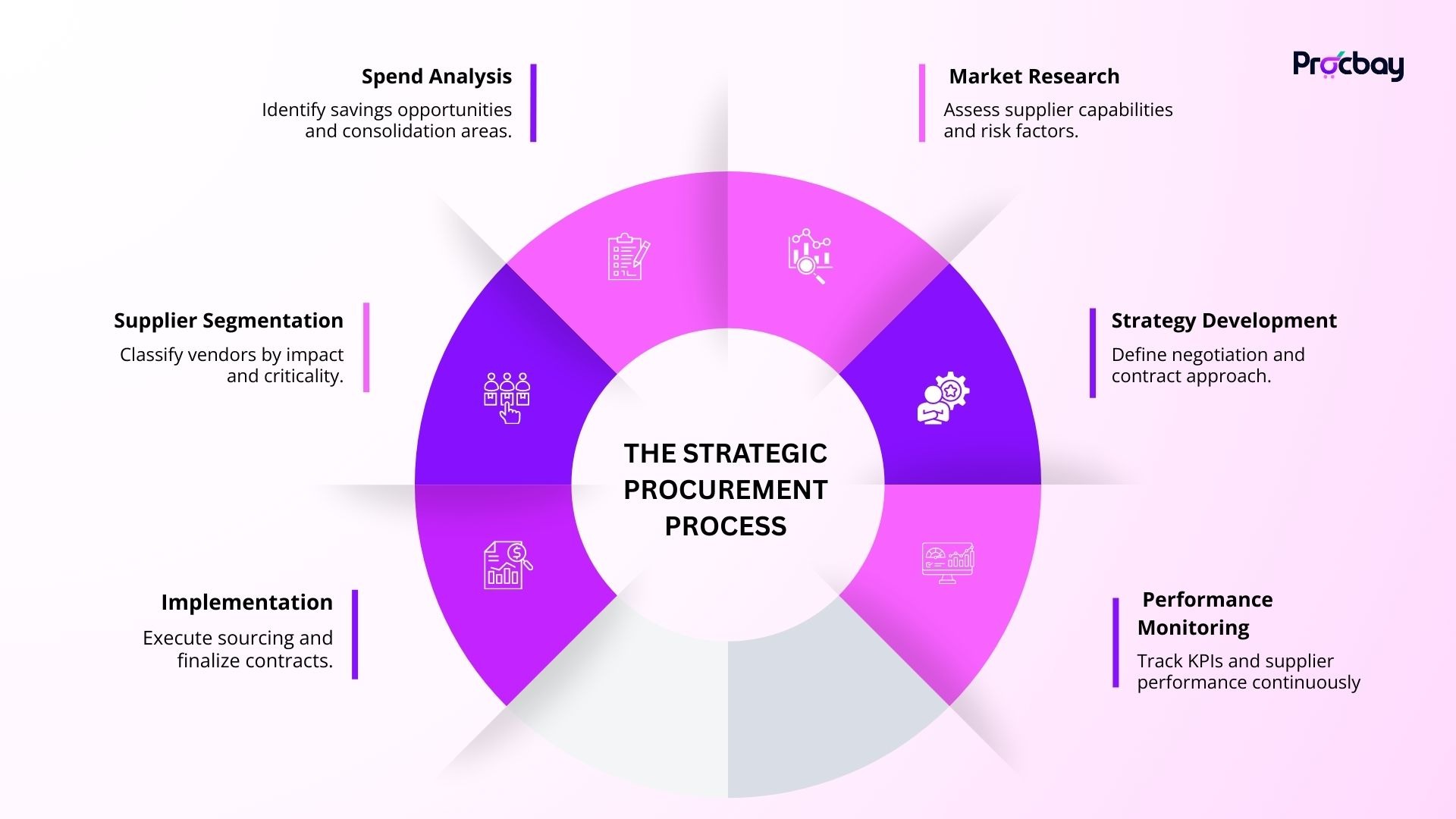
A structured strategic procurement process helps ensure that procurement decisions are aligned with overall business objectives. A structured step-by-step process is outlined below:
Step 1: Spend Analysis
Analysis of historical spend to determine areas of potential savings and consolidation.
Step 2: Market Research
Evaluation of supplier capabilities and risk considerations.
Step 3: Supplier Segmentation
Vendor segmentation is based on impact and criticality.
Step 4: Strategy Development
Development of negotiation and contract strategy.
Step 5: Implementation
Implementation of procurement activities and contract development.
Step 6: Performance Monitoring
Tracking of KPIs and supplier performance on an ongoing basis.
This framework helps move procurement from a buying to a strategic procurement process.
Sourcing Strategies in Procurement That Deliver Measurable Results
Effective organizations use effective sourcing techniques in procurement to maximize supplier value. They consider the total cost of ownership instead of just looking at the cost. Risk diversification and innovation are also important considerations.
Some of the sourcing strategies in procurement that are commonly used include multi-sourcing to mitigate dependency risk and category management to align spending with business strategies. Research indicates that effective category management can cut external spending by as much as 12%.
DID YOU KNOW?
Research shows that organizations implementing structured strategic sourcing and category management can achieve 10–20% cost reductions across spend categories.
Strategic Sourcing Best Practices for Long-Term Value
To drive sustainable value, discipline, and focus on execution is needed. The following strategic sourcing best practices will enable companies to enhance cost management and supplier performance without increasing complexity.
- Analyze Spend
Assess data to uncover areas of savings potential and supplier consolidation opportunities.
- Align with Strategy
Align sourcing strategies with overall business and risk strategies.
- Build Supplier Partnerships
Emphasize Supplier relationship management with defined KPIs to drive reliability and innovation.
- Leverage Digital Technology
Implement strategic sourcing solutions to improve data visibility and compliance.
- Monitor Performance
Continuously monitor supplier performance to ensure sustainable value is achieved.
By incorporating these best practices, procurement professionals can shift from cost savings to strategic sustainable value.
Technology and Strategic Sourcing Solutions
Contemporary businesses use strategic sourcing solutions to deal with supplier complexity and compliance requirements. Digital procurement platforms are used to automate RFP processes, contract management, and supplier engagement, thus improving overall procurement transformation projects.
Industry research shows that procurement digitalization can increase productivity by over 30%. When combined with sourcing strategies in procurement, digital platforms improve enterprise alignment and visibility by:
- Centralized Spend Visibility
- Automated RFP Processes
- Contract Management
- Supplier Risk Monitoring
- Data-Driven Insights
These features enable enterprises to align sourcing execution with strategic plans while sustaining efficiency.
DID YOU KNOW?
Digital procurement and automation can improve procurement efficiency and productivity by up to 30%.
Strategic Procurement in Practice: Business Impact
Strategic procurement helps to align procurement decisions with the overall business strategy. This helps to increase leverage and accountability in procurement. Organizations that adopt disciplined sourcing strategies can gain double-digit cost savings and higher compliance rates.
By integrating sourcing with a strategic procurement process, organizations can shift from a reactive procurement approach. This is why it is important to understand strategic sourcing vs procurement.
Brand Authority: Enabling Strategic Procurement Excellence
Procbay offers a comprehensive digital procurement platform that aims to integrate sourcing strategies in procurement, with operational execution. The platform combines supplier onboarding, compliance processes, and contract management within a single environment.
With the ability to support structured governance and data visibility, Procbay improves transparency and minimizes manual processing. Organizations requiring scalable strategic sourcing solutions can leverage digital automation that aligns with strategic procurement goals.
Build a Future-Ready Procurement Strategy
A clear understanding of strategic sourcing vs procurement can help organizations better define roles, responsibilities, and performance metrics. Procurement is the process that ensures business continuity. Strategic sourcing determines supplier strategy and value-creation.
By being part of a defined strategic procurement process, both activities can improve cost management, compliance, and supplier innovation.
Assess your current sourcing maturity and governance model. Discover how Procbay can help with structured execution and supplier value creation.
Key Takeaways
- Strategic sourcing solutions enhance cost control, supplier performance, and compliance management.
- Integrating technology with sourcing strategies in procurement improves visibility and operational efficiency.
- Data-driven decision-making strengthens long-term value creation and enterprise-wide alignment.
Frequently Asked Questions (FAQs)
Q: What is the difference between strategic sourcing vs procurement?
A: The difference between strategic sourcing vs procurement lies in scope and time horizon. Procurement focuses on transactional purchasing activities. Strategic sourcing evaluates supplier markets and long-term value creation before contracts are finalized.
Q: What are sourcing strategies in procurement?
A: Sourcing strategies in procurement refer to structured approaches such as category management and multi-sourcing. These methods reduce supplier risk and optimize overall cost efficiency.
Q: What is included in the strategic procurement process?
A: The strategic procurement process includes spend analysis, supplier evaluation, negotiation planning, contract execution, and performance monitoring. It ensures procurement decisions align with long-term business objectives.
Q: How do digital tools improve procurement performance?
A: Digital procurement tools automate approvals, improve compliance tracking, and centralize supplier information. They enhance transparency and reduce processing errors across departments.
Q: Why are strategic sourcing solutions important for growth?
A: Strategic sourcing solutions enable data-driven supplier selection, workflow automation, and risk monitoring. They help organizations scale operations while maintaining governance and cost control.
Connect with our procurement experts to tailor an AI-governed sourcing strategy for your enterprise.
Contact Us